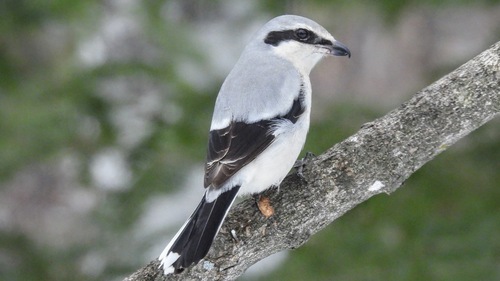
Northern Shrike
Lanius borealis
The Northern Shrike is a fierce 'Butcherbird' that hides a predator's soul beneath a songbird's feathers. A master of the winter landscape, this masked hunter is the only songbird that regularly preys on vertebrate animals.
Quick Identification
Size
Length: 9.1–10.2 in (23–26 cm); Wingspan: 11.8–13.8 in (30–35 cm); Weight: 2.0–3.3 oz (56–93 g)
Colors
Cool gray crown and back, white underparts with fine dusky barring, black wings with white patches, and a thick black mask that stops at the base of the bill.
Key Features
- Strongly hooked, raptor-like upper mandible
- Black mask through the eyes that does not bridge over the beak
- Wide white wing patches visible during flight
- Long, black tail with white outer feathers
When You’ll See Them
Behavior
Despite its appearance as a typical songbird, the Northern Shrike is a formidable predator, often referred to as the 'Butcherbird.' Lacking the powerful talons of a hawk, this species has developed the unique behavior of impaling its prey—including large insects, small mammals, and other birds—onto thorns or barbed wire. This 'larder' serves both as a food storage system for leaner times and as a way to secure prey while the shrike uses its hooked beak to tear it apart.
In the backyard setting, you will typically see them perched solitary on the highest possible branch or utility wire, scanning the ground for movement. They are highly territorial during the winter and will chase away other birds. Interestingly, they are also skilled mimics; they often sing complex, quiet songs during the winter that incorporate the calls of other birds, possibly to lure smaller species within striking distance.
EverydayEarth exclusive
Camera Tips
To capture the Northern Shrike on camera, you must focus on their hunting strategy. Unlike seed-eating birds, shrikes won't visit a traditional feeder. Instead, place your camera facing a prominent, high-altitude 'sentinel' perch. Look for isolated snags, the very tops of coniferous trees, or even the top of a bird feeder pole. Position the camera at a slightly upward angle if the perch is within 10–15 feet to capture their characteristic scanning behavior and dramatic diving departures.
A highly effective way to get close-up action is to locate a shrike's 'larder.' If you find a hawthorn tree, a thorny locust, or a stretch of barbed wire with prey remains (like a grasshopper or a small rodent) pinned to it, set your camera there immediately. The shrike will almost certainly return to finish its meal or add to its collection. Set your camera’s trigger speed to the fastest possible setting, as their pounces are lightning-quick and often occur from a great height.
Because these birds are winter visitors in many areas, battery management is crucial. Use lithium batteries to ensure your camera stays active in freezing temperatures. For the best image quality, try to position the camera so the sun is behind it; the Northern Shrike’s gray and white plumage can easily become 'blown out' or overexposed against a bright, snowy background. Use a medium-to-high sensitivity setting on your PIR sensor, as shrikes are relatively small targets compared to deer or coyotes.
Lastly, don't ignore the ground. While they perch high, they kill low. If you have a brush pile in your yard that attracts sparrows or juncos, aim a secondary camera at a nearby low branch or fence post about 3–5 feet off the ground. Shrikes often pause there for a split second before or after an ambush attempt on the smaller birds gathered below.
Similar Species
Species that look similar or are commonly confused with Northern Shrike.
Loggerhead Shrike
Smaller with a darker black mask that fully crosses the bridge of the nose; lacks the fine horizontal chest barring of the Northern Shrike.
Northern Mockingbird
Similar gray and white colors but lacks the black face mask and hooked predatory beak; has much larger white patches on the wings and tail.
Frequently Asked Questions
Record Northern Shrike at your habitat
Connect a camera to start building your own species record — AI identifies every visitor automatically.