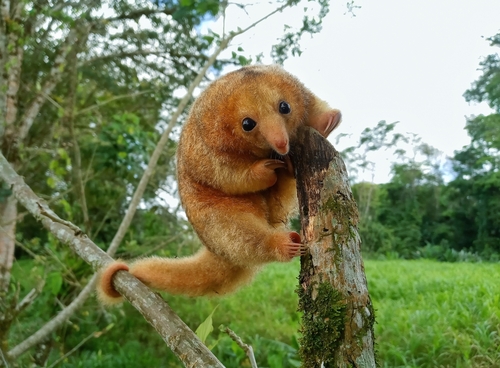
Northern Silky Anteater
Cyclopes dorsalis
The world's smallest anteater is a golden, tree-dwelling marvel that moves through the canopy like a ghost. Rare and remarkably cute, the Northern Silky Anteater is the ultimate prize for any tropical backyard camera enthusiast.
Quick Identification
Size
Total length of 36–45 cm (14–18 in); weight of 175–400 g (6–14 oz)
Colors
Silky golden-yellow to brownish-grey fur, often featuring a faint dark dorsal stripe and a paler underside.
Key Features
- Miniature size, roughly the scale of a squirrel
- Two curved claws on each front paw
- Prehensile tail used as a fifth limb
- Thick, woolly fur that resembles a seed pod
When You’ll See Them
Behavior
The Northern Silky Anteater is a master of camouflage and slow-motion living. Strictly arboreal and nocturnal, these tiny mammals spend their entire lives in the forest canopy, rarely descending to the ground. During the day, they curl into a tight ball, resembling the fibrous seed pods of the silk-cotton (Ceiba) tree, which helps them avoid detection by hawks and harpy eagles. They are solitary creatures, moving with deliberate, sloth-like precision through the vines and branches.
When threatened, the Northern Silky Anteater displays a unique defensive posture: it stands on its hind legs using its prehensile tail for balance and raises its front claws near its face, ready to strike like a boxer. Despite their adorable appearance, those claws are sharp and effective for their size. They are generally shy and have no significant interactions with humans, as their habitat remains high above our eye level.
EverydayEarth exclusive
Camera Tips
Capturing a Northern Silky Anteater on camera requires a departure from traditional trail cam techniques. Since these animals never touch the ground, your camera must be mounted high in the canopy. Look for 'arboreal highways'—thick lianas, vines, or horizontal branches that bridge gaps between tree crowns. Using a climbing harness or a long-reach pole, position the camera 10 to 20 feet up, angled slightly downward to capture the animal as it traverses the branch.
Because they are nocturnal and very small, standard motion sensors may struggle to trigger. Use a camera with a high-sensitivity PIR (Passive Infrared) sensor and set it to a high-speed burst mode or short video clips. Since their golden fur reflects light well, ensure your IR (Infrared) flash isn't too powerful at close range, or you risk 'white-out' photos. A 'No-Glow' or 'Black IR' flash is essential to avoid spooking the animal or attracting the attention of larger predators.
There are no commercial lures for silky anteaters, but placement is everything. They are frequently found in Ceiba trees because the fluffy seed pods provide perfect camouflage. If you have a fruiting Ceiba or a tree with a high concentration of arboreal ant nests (like Cecropia), focus your efforts there. Ensure your camera's focus is set correctly for close-up action, as a branch just 3-5 feet away will be the most likely path for this tiny climber.
Similar Species
Species that look similar or are commonly confused with Northern Silky Anteater.
Frequently Asked Questions
Record Northern Silky Anteater at your habitat
Connect a camera to start building your own species record — AI identifies every visitor automatically.