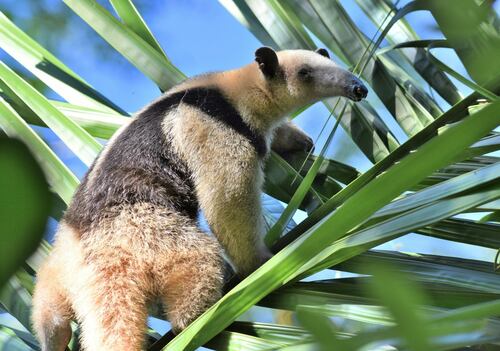
Northern Tamandua
Tamandua mexicana
Meet the 'Stinkpot of the Woods,' a stylishly vested acrobat that roams the tropical canopy. With a prehensile tail and a tongue longer than its head, the Northern Tamandua is nature's most specialized pest control expert.
Quick Identification
Size
Total length 102–130 cm (40–51 in); Weight 3.2–5.4 kg (7.1–11.9 lb)
Colors
Tan to pale yellow fur with a distinctive black 'vest' across the back and shoulders; the tail is partially hairless with pinkish skin and dark mottling.
Key Features
- Distinctive black 'V' or vest-like marking on back
- Strong prehensile tail used for climbing
- Elongated, toothless snout
- Four large, curved claws on front paws used for digging
When You’ll See Them
Behavior
The Northern Tamandua is a fascinating semi-arboreal mammal, meaning it is equally comfortable moving through the forest canopy as it is walking on the ground. They are generally solitary creatures, moving with a slightly awkward, 'clumsy' gait on the floor because they must walk on the sides of their hands to protect their long, sharp claws. However, once they reach a tree, they become incredibly agile, using their powerful prehensile tail as a fifth limb to secure themselves while reaching for ant or termite nests.
These anteaters are famous for their unique defensive posture. When they feel cornered and cannot retreat into a tree or a burrow, they stand on their hind legs and use their tail as a tripod for balance. From this 'tripod' position, they spread their arms wide to appear larger and lash out with their formidable claws. While they are generally peaceful and avoid humans, they possess a strong-smelling musk gland that has earned them the local nickname 'stinkpot of the woods,' which they use to mark their territory and deter predators.
EverydayEarth exclusive
Camera Tips
To successfully capture a Northern Tamandua on your backyard or trail camera, you need to think vertically. While many mammals are best caught at ground level, the Tamandua is a climber. Look for 'natural bridges' such as large fallen logs or horizontal branches that connect different parts of the canopy. Mounting your camera 5 to 8 feet up a tree trunk and angling it downward toward a sturdy branch can yield spectacular footage of them using their prehensile tails for balance. If you are restricted to ground mounting, place the camera near the base of large, hollow trees or near active termite mounds.
Since they are primarily nocturnal, your camera’s infrared (IR) capabilities are crucial. These animals have light-colored fur that can easily 'white out' or overexpose if the IR flash is too close or too powerful. Position your camera at least 10–15 feet away from the expected path to ensure the light spreads evenly, allowing the camera to pick up the high-contrast black 'vest' pattern against their tan fur. Set your camera to 'Video Mode' with a duration of at least 20 seconds; watching a Tamandua use its claws to peel back tree bark or navigate a vine is far more rewarding than a single blurry photo.
While we discourage the use of food bait, you can take advantage of their natural foraging habits. If you notice a tree with freshly ripped-away bark or a termite mound with a new hole in the side, that is your prime location. Tamanduas are creatures of habit and will often revisit productive feeding sites over the course of several nights. In suburban environments, they frequently use the tops of fences as secure travel corridors to avoid dogs on the ground, so a camera mounted along a fence line bordering a wooded area is a pro-level strategy.
Finally, be mindful of the tropical environment. Northern Tamanduas live in high-humidity areas, which can lead to lens fogging at dawn and dusk. Using a small 'rain hood' over the camera or placing a desiccant pack inside the battery compartment can help keep your images crisp. If you are in an area where they are active during the day (which occasionally happens in dense forest cover), ensure your camera is positioned to avoid direct sunlight hitting the lens, which can trigger false positives or wash out the beautiful golden tones of their fur.
Similar Species
Species that look similar or are commonly confused with Northern Tamandua.
Frequently Asked Questions
Record Northern Tamandua at your habitat
Connect a camera to start building your own species record — AI identifies every visitor automatically.