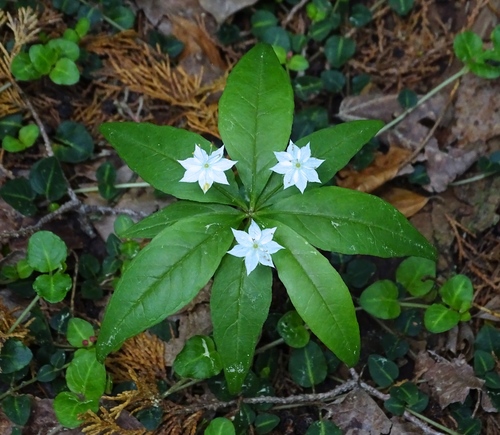
northern starflower
Lysimachia borealis
A shimmering white star of the northern forest floor, the Northern Starflower is a master of the shaded understory. Its unique seven-petaled bloom and elegant leaf whorl make it a favorite for woodland explorers and macro photographers.
Quick Identification
Size
Height: 5–20 cm (2–8 inches); Flower diameter: 1–1.5 cm (0.4–0.6 inches)
Colors
Brilliant white flowers with yellow-tipped stamens; bright green leaves; occasionally reddish-brown stems
Key Features
- Usually 7 pointed white petals forming a perfect star
- Whorl of 5 to 9 lance-shaped leaves at the stem apex
- Very thin, wiry flower stalks supporting 1-2 blooms
- Creeping underground rhizomes that form small colonies
When You’ll See Them
Geographic range
Where Does the northern starflower Live?
The Northern Starflower is a quintessential resident of the northern reaches of North America. It is found abundantly across Canada, from the Atlantic provinces to British Columbia and into Alaska, and extends its reach into the northern United States. In the east, its range follows the cooling influence of the Appalachian Mountains as far south as Virginia and Tennessee, where it persists only in high-altitude, moisture-rich environments that mimic the northern boreal forests.
Basemap © OpenStreetMap contributors
Behavior
The Northern Starflower is a delicate forest-floor perennial that signals the peak of spring in northern woodlands. It spreads primarily through slender, creeping rhizomes, often forming small, shimmering colonies that carpet the shaded earth. Unlike many woodland flowers that provide nectar to lure insects, the Starflower is a 'pollen-only' plant. It relies on small solitary bees and hoverflies that visit to collect its nutritious pollen, unintentionally aiding in the plant's reproduction.
As a master of the understory, this species has adapted to survive in low-light environments. It completes its blooming cycle quickly between May and June, taking advantage of the sunlight that reaches the forest floor before the tree canopy fully closes. While it is not consumed by many large animals due to its small size and lack of significant foliage, it provides essential early-season resources for specialized forest insects.
EverydayEarth exclusive
Camera Tips
Capturing the Northern Starflower with a trail camera requires a specialized setup focused on macro-level detail. Because the plant stands only a few inches high, you must mount your camera at ground level using a low-profile stake or a small flexible tripod. If your camera has a 'macro' mode or a narrow focal range, use it to ensure the delicate seven-pointed petals are in sharp focus. This low angle also captures the 'whorl' of leaves, which is a key identification feature from a side profile.
Timing is critical for this species; use your AI camera’s time-lapse feature during the peak blooming weeks of late May and early June. Set the interval to capture a photo every 15 to 30 minutes during daylight hours. This allows you to document the 'solar tracking' of the flowers and the arrival of tiny pollinators that move too fast for standard motion triggers. Since these flowers are bright white, they can easily 'blow out' in direct sunlight, so aim for a placement where the lighting is consistent and filtered through the canopy.
For the best results, look for a cluster or 'colony' of Starflowers rather than a single stem. A group provides a more visually interesting subject and increases the likelihood of capturing insect activity. If your camera allows for manual exposure settings, slightly underexpose the image to preserve the intricate details of the white petals. Avoid using a flash at night, as the plant is dormant and the reflective white petals will likely cause a glare that obscures the plant's structure.
Similar Species
Species that look similar or are commonly confused with northern starflower.
Frequently Asked Questions
Record northern starflower at your habitat
Connect a camera to start building your own species record — AI identifies every visitor automatically.