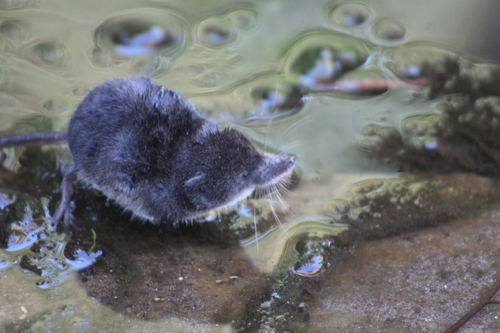
Northern Water Shrew
Sorex palustris
The Northern Water Shrew is nature’s tiny scuba diver, capable of diving to stream bottoms and even running across the surface of the water.
Quick Identification
Size
Length: 13-17 cm (5-6.7 in); Weight: 8-18 g (0.3-0.6 oz)
Colors
Dorsal side is dark grey to near-black; underbelly is a contrasting silvery-white or light grey
Key Features
- Stiff fringe of silver hairs on the sides of the hind feet for swimming
- Long, pointed snout with prominent whiskers
- Small, inconspicuous eyes and ears
- Velvety, water-repellent fur
When You’ll See Them
Geographic range
Where Does the Northern Water Shrew Live?
Native to the North American continent, the Northern Water Shrew occupies a vast territory stretching from the wild landscapes of Alaska and across the breadth of Canada. In the United States, its presence is most notable along major mountain corridors and northern border states, extending southward through the Rockies, the Appalachians, and the Sierra Nevada where clean, oxygen-rich water is abundant.
Basemap © OpenStreetMap contributors
Behavior
The Northern Water Shrew is a high-octane powerhouse of the mammal world. As the smallest mammalian diver, it possesses an incredibly high metabolism that requires it to hunt almost continuously, day and night. It is a solitary and fiercely territorial creature, spending its life in a cycle of frantic foraging followed by short periods of deep sleep. Its most remarkable trick is its ability to 'run on water'; by trapping air bubbles in the stiff hairs of its feet, it can generate enough surface tension to skitter across a pond's surface without sinking.
In the water, these shrews are surprisingly agile. They use their large hind feet as paddles to dive to the bottom of streams and ponds in search of prey. Because their thick fur traps so much air for insulation, they are extremely buoyant and must swim vigorously to stay submerged. While they are rarely seen by humans due to their small size and rapid movements, they are vital indicators of clean, unpolluted water sources.
EverydayEarth exclusive
Camera Tips
Capturing a Northern Water Shrew on camera requires precision and a focus on 'micro-habitats.' Because of their tiny mass, they often fail to trigger standard PIR (Passive Infrared) sensors on budget trail cameras. To increase your chances, look for 'shrew highways'—naturally occurring bridges like fallen logs that cross small streams or mossy rocks at the water's edge. Position your camera just 4 to 6 inches above the ground, aimed directly at the surface of these transit points.
Standard photo mode often results in a blur due to the shrew's rapid, twitchy movements. Instead, set your camera to high-definition video mode with the highest possible frame rate (at least 30fps, though 60fps is better). This allows you to witness their unique swimming and diving behaviors in slow motion. If your camera has a 'close focus' or macro lens attachment, now is the time to use it, as the best shots are usually taken from less than three feet away.
While they are active 24/7, ensure your camera has a fast-recovery infrared flash for night captures. They are extremely sensitive to scent; avoid touching the camera or the surrounding area with bare hands. Baiting is rarely necessary if you find a high-traffic stream bank, but a small amount of fish-based cat food or mealworms placed on a flat rock in front of the lens can pause their frantic movement long enough for a clear shot. Check your footage frequently, as these little dynamos can fill an SD card with activity in a single night.
Similar Species
Species that look similar or are commonly confused with Northern Water Shrew.
Frequently Asked Questions
Record Northern Water Shrew at your habitat
Connect a camera to start building your own species record — AI identifies every visitor automatically.