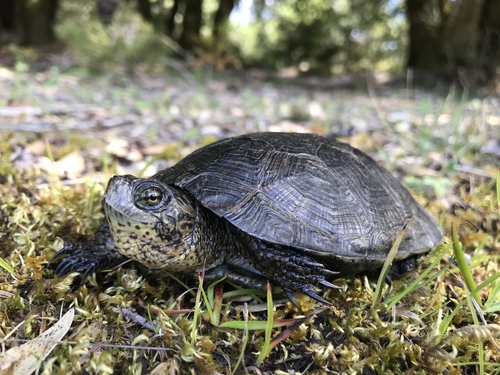
Northwestern Pond Turtle
Actinemys marmorata
The only native freshwater turtle of the Pacific Northwest, this shy 'sun-worshiper' is a master of disappearing at the first sign of trouble. Spotting one is a true reward for the patient backyard naturalist.
Quick Identification
Size
Carapace length of 11–21 cm (4.5–8.25 inches); weights range from 400–900 grams (0.9–2 lbs)
Colors
Dull olive, dark brown, or blackish shell with fine radiating black lines; yellowish or cream plastron and throat
Key Features
- Carapace covered in fine, radiating black lines or speckles
- Uniformly yellowish or pale throat without bright stripes
- Low-domed, smooth shell profile
- Small to medium-sized build with a relatively long tail
When You’ll See Them
Geographic range
Where Does the Northwestern Pond Turtle Live?
The Northwestern Pond Turtle is native to the western coast of North America, with its primary range extending from the Puget Sound in Washington through western Oregon and into Northern and Central California. While historically found as far north as British Columbia, the species is now considered extirpated in Canada, leaving the Pacific Northwest and California as its last strongholds. These turtles are typically found in lowland drainages west of the Cascade and Sierra Nevada mountain ranges, though isolated populations exist in a few interior valleys.
Basemap © OpenStreetMap contributors
Behavior
Northwestern Pond Turtles are famously shy and wary. They spend a significant portion of their day basking on logs, rocks, or mats of floating vegetation to regulate their body temperature. However, they are highly sensitive to movement and vibration; at the slightest hint of a human or predator, they will quickly slide into the water and may remain submerged at the bottom for up to an hour.
While primarily aquatic, these turtles are surprisingly mobile on land. In late spring and early summer, females travel significant distances away from the water to find suitable upland nesting sites in sunny, well-drained soil. During the winter months or during periods of extreme drought, they may also bury themselves in leaf litter or soil in upland areas to enter a state of dormancy known as brumation.
EverydayEarth exclusive
Camera Tips
The secret to capturing high-quality footage of the Northwestern Pond Turtle is identifying a 'hot spot' basking log. Look for partially submerged timber or flat rocks that receive direct sunlight for several hours a day. Mount your camera on a nearby tree or a stake driven into the bank, aiming it at a 45-degree angle toward the basking site. Because these turtles are so skittish, a remote camera is often the only way to see them behaving naturally without them diving for cover.
Since basking is a stationary activity, use a camera with a high-sensitivity PIR sensor or, better yet, utilize a time-lapse mode. Setting your camera to take a photo every 5 to 10 minutes between 10:00 AM and 3:00 PM will ensure you capture them even if they aren't moving enough to trigger a standard motion sensor. If your camera allows for it, use a higher resolution setting to allow for cropping, as you'll want to keep the camera at a respectful distance (at least 10–15 feet) to avoid disturbing the habitat.
During the nesting season (May through July), you can broaden your search to upland areas. Position cameras along game trails leading from the water to open, sunny meadows or hillsides. Females often follow the same paths year after year to reach their nesting grounds. Look for signs of disturbed soil or small, flask-shaped holes, which indicate a turtle has been digging.
Lighting is your biggest challenge near water. To avoid 'white-out' photos caused by sun reflecting off the water's surface, try to position the camera so the sun is behind it. A lens hood or a small piece of dark plastic taped above the lens can help reduce glare. If you are using a trail camera for video, set the clip length to at least 20 seconds to capture the slow, methodical way they climb onto logs and adjust their limbs to soak up the sun.
Similar Species
Species that look similar or are commonly confused with Northwestern Pond Turtle.
Frequently Asked Questions
Record Northwestern Pond Turtle at your habitat
Connect a camera to start building your own species record — AI identifies every visitor automatically.