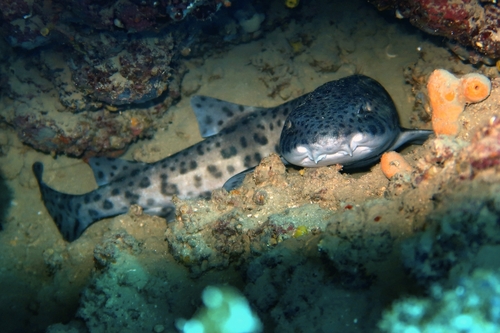
Nursehound
Scyliorhinus stellaris
A master of disguise among the kelp, the Nursehound is a striking, large-spotted catshark that brings a touch of prehistoric mystery to our coastal waters. Known for its docility and beautiful markings, it is a favorite for underwater observers and night-time explorers.
Quick Identification
Size
Typically 1.2 to 1.6 m (3.9 to 5.2 ft) in length; weights range from 5 to 10 kg (11 to 22 lbs).
Colors
Creamy brown or grayish base color covered in large, prominent dark brown or black spots, occasionally interspersed with small white dots. The underside is a uniform pale white or light grey.
Key Features
- Broad, rounded head with a robust body
- Large, widely spaced dark spots across the entire back and sides
- Nasal skin flaps that are distinct and do not reach the mouth
- Two dorsal fins located significantly far back on the body
When You’ll See Them
Behavior
The nursehound is a nocturnal predator that spends its daylight hours tucked away in rocky crevices or nestled among thick kelp forests. Unlike many of its more active shark relatives, this species is a 'sit-and-wait' or slow-cruising hunter, relying on its excellent sense of smell to track down prey along the seafloor during the dark hours. They are generally solitary creatures, though they may congregate in specific areas that offer prime shelter from stronger currents.
While they are members of the shark family, nursehounds are known for their docile nature toward humans. Divers often encounter them resting motionlessly on the seabed. However, they are powerful for their size and have very rough, sandpaper-like skin (dermal denticles) and strong jaws, so they should be observed with respect. In the spring and summer, females move into shallower waters to attach their tough, leathery egg cases—commonly known as 'mermaids' purses'—to seaweed and upright structures.
EverydayEarth exclusive
Camera Tips
Capturing a nursehound on camera requires a specialized underwater setup, as these are marine animals. For those with 'blue backyards'—coastal piers or rocky shorelines—the most effective method is using a submersible trail camera or an action camera in a waterproof housing with an external battery pack. Position your camera near the base of a rocky reef or at the edge of a kelp forest, as nursehounds use these features as highways for nighttime hunting. The camera should be angled slightly upward or horizontally across a flat sandy patch adjacent to the rocks to catch the shark's silhouette as it cruises by.
Since nursehounds are strictly nocturnal, high-quality infrared (IR) lighting is essential. White light can startle marine life and cause backscatter (reflecting off particles in the water), whereas IR or low-glow red LEDs are less intrusive and provide a clearer view of the shark's unique spot patterns. Set your camera to record video rather than stills; the undulating movement of a shark is much easier to identify than a blurred photo in dark water. Use a high frame rate if possible to ensure the footage is smooth.
To guarantee a visit, use a scent-based lure. A mesh 'bait bag' filled with oily fish like mackerel or sardines, secured firmly in front of the camera (but not blocking the lens), will draw nursehounds from down-current. Ensure your rig is heavily weighted—at least 5-10kg—to prevent it from being moved by tides or the curiosity of larger marine life. In the spring, you can also place cameras near vertical seaweed structures to capture rare footage of females depositing their egg cases.
Similar Species
Species that look similar or are commonly confused with Nursehound.
Frequently Asked Questions
Record Nursehound at your habitat
Connect a camera to start building your own species record — AI identifies every visitor automatically.