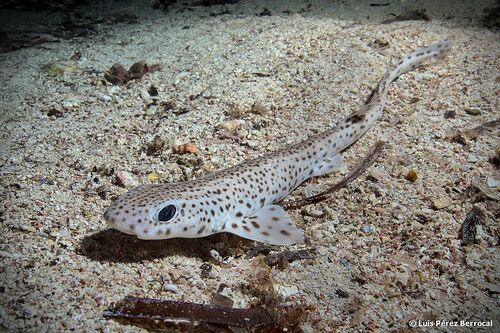
Small-spotted Catshark
Scyliorhinus canicula
The Small-spotted Catshark is the hidden gem of our coastal shallows, a master of camouflage that prowls the seafloor with cat-like grace. Known for its beautiful dappled skin and gentle nature, it brings a touch of deep-sea mystery to the shoreline.
Quick Identification
Size
Typically 60–80 cm (24–31 inches) long, reaching a maximum of 1 meter (3.3 feet); weight averages 1–2 kg (2.2–4.4 lbs).
Colors
Sandy-brown to light grey upper body densely covered in small, dark brown or black spots; the belly is a pale, creamy white.
Key Features
- Numerous small dark spots across the entire body
- Two small dorsal fins located far back on the body
- Elongated 'cat-like' eyes with oval pupils
- Five small gill slits located above the pectoral fins
When You’ll See Them
Behavior
The Small-spotted Catshark is a primarily nocturnal species that spends its daylight hours resting sluggishly on the seafloor, often tucked away in crevices or among thick kelp forests. Despite being a member of the shark family, they are incredibly docile and pose no threat to humans, often remaining perfectly still even when approached by divers. They are known for a peculiar 'curling' behavior when threatened, where they wrap their tail around their head to protect their eyes.
Socially, these sharks are often found in groups of the same sex, a behavior known as sexual segregation. Males and females tend to occupy different depths or habitats outside of the mating season to avoid competition. They are highly sedentary creatures, often returning to the same favored resting spot day after day, which makes them excellent subjects for long-term camera observation if you live near a rocky coastline.
EverydayEarth exclusive
Camera Tips
Capturing a Small-spotted Catshark on camera requires an underwater setup, specifically targeting the 'intertidal zone' or shallow reefs if your property borders the ocean. For those with coastal backyards, a waterproof trail camera or an action camera with an external power bank inside a dive housing is the best approach. Position the camera at the base of a rock face or at the edge of a kelp bed, as these sharks use these features as 'highways' to navigate the seabed while staying protected from larger predators.
Since these sharks are strictly nocturnal, your camera’s infrared (IR) capabilities are vital. However, catsharks are sensitive to bright light; if your camera allows it, use 'Low Glow' or 'No Glow' IR settings to prevent them from darting away. Angle the camera slightly downward toward the seafloor, about 6 to 12 inches off the bottom, to capture their unique 'walking' motion as they use their pectoral fins to push along the sand. Setting a high-frame-rate video mode is better than stills, as it allows you to see the rhythmic undulating movement of their tail.
To guarantee a sighting, you can use a scent lure. A perforated PVC pipe filled with oily fish like mackerel or sardines (often called a 'chum pod') can be staked into the sand directly in front of the lens. The catshark’s powerful ampullae of Lorenzini (electro-receptors) and sense of smell will lead them directly to the bait. Just ensure the bait is secured so the shark doesn't drag it out of the frame immediately. If you are filming in a tide pool during low tide, check the water depth to ensure the camera remains fully submerged as the tide recedes.
Similar Species
Species that look similar or are commonly confused with Small-spotted Catshark.
Frequently Asked Questions
Record Small-spotted Catshark at your habitat
Connect a camera to start building your own species record — AI identifies every visitor automatically.