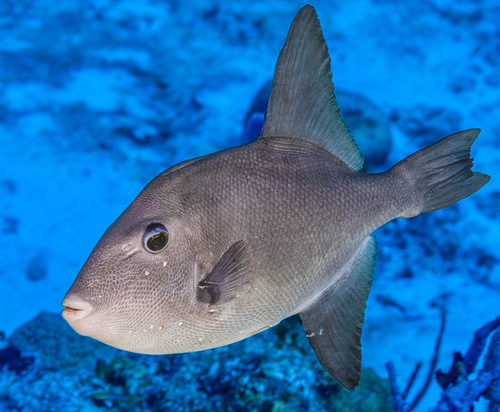
Oceanic Triggerfish
Canthidermis sufflamen
A hardy wanderer of the Western Atlantic, the Oceanic Triggerfish is a master of the open blue. Known for its leathery skin and curious gaze, it is often found patrolling the surface near drifting ocean debris.
Quick Identification
Size
Typically 30-50 cm (12-20 in) in length, reaching a maximum of 65 cm (26 in) and weighing up to 6.1 kg (13.5 lbs).
Colors
Uniform grayish-brown to bronze; features a distinct dark, almost black blotch at the base of the pectoral fin.
Key Features
- Deep, oval-shaped body compressed laterally
- Prominent dark spot at the base of the pectoral fin
- Large eyes set high and far back on the head
- Tough, leathery skin with sand-papery scales
- Tall, triangular dorsal and anal fins set toward the rear
When You’ll See Them
Geographic range
Where Does the Oceanic Triggerfish Live?
The Oceanic Triggerfish is native to the warm waters of the Western Atlantic Ocean. Its primary range spans from the Caribbean Sea and the Gulf of Mexico up to the coast of Florida, though individuals occasionally wander as far north as Massachusetts during the peak of summer. To the south, they are commonly found along the tropical coastlines of Brazil and surrounding island chains.
Basemap © OpenStreetMap contributors
Behavior
The Oceanic Triggerfish is a pelagic species, meaning it prefers the open ocean over the confined crevices of a reef. Unlike many of its cousins, it is frequently found drifting near the surface, often seeking out floating objects like logs, buoys, or mats of Sargassum seaweed. They are known for a curious but cautious temperament, often approaching divers or cameras to investigate their reflections before retreating back into the blue.
While generally solitary or found in small loose groups, their behavior changes during the breeding season. Males move toward outer reef slopes or sandy flats to excavate large, bowl-shaped nests. During this time, they become fiercely territorial and are famous for defending their eggs against much larger intruders, including human divers, by charging or nipping with their strong, beak-like teeth.
EverydayEarth exclusive
Camera Tips
To capture the Oceanic Triggerfish on an AI-powered camera, you will need a waterproof setup specifically designed for underwater use. Because this species is pelagic and attracted to structure, the best placement for a camera is on a submerged dock piling or suspended from a buoy in clear, coastal water. Position the camera at a depth of 5 to 10 feet, angling it slightly upward toward the surface to take advantage of natural light, which helps define the fish's silhouette against the bright water column.
A unique trick for attracting this specific species is to utilize their attraction to floating objects. You can create a 'mini-FAD' (Fish Aggregating Device) by safely tethering a small piece of clean, floating wood or a bundle of palm fronds within the camera's field of view. The Oceanic Triggerfish will often approach these objects to forage for small crustaceans or simply to seek shade, providing you with long, clear sequences as they circle the structure.
Set your camera to a high frame rate if possible. Triggerfish move their dorsal and anal fins in a beautiful, undulating wave-like motion to swim, which can look blurred on standard settings. Because the water filters out red light, your footage may look very blue; if your camera doesn't have a built-in red filter, try to record during the middle of the day (10 AM to 2 PM) when the sun is directly overhead to get the most accurate color representation of their bronze-gray skin and that signature dark pectoral spot.
Similar Species
Species that look similar or are commonly confused with Oceanic Triggerfish.
Frequently Asked Questions
Record Oceanic Triggerfish at your habitat
Connect a camera to start building your own species record — AI identifies every visitor automatically.