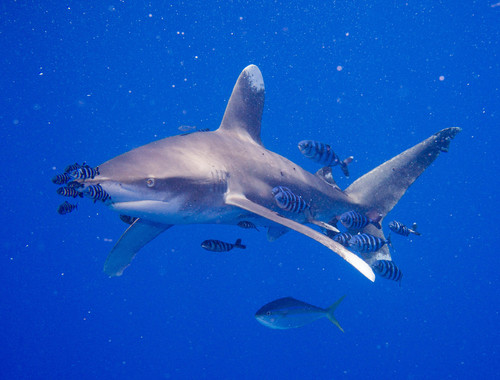
Oceanic Whitetip Shark
Carcharhinus longimanus
The ultimate nomad of the deep blue, the Oceanic Whitetip Shark is a bold, inquisitive predator known for its iconic white-tipped fins and incredible migratory journeys.
Quick Identification
Size
Typically 2.5 to 3.5 meters (8 to 11.5 feet) in length; weights range from 70 to 170 kg (150 to 375 lbs).
Colors
Bronze-grey to brown on the upper body, fading to a stark white underside. Mottled white markings on the tips of the dorsal, pectoral, and tail fins.
Key Features
- Exceptionally long, paddle-like pectoral fins
- Broad, rounded first dorsal fin with distinctive white mottling
- Stocky, powerful build with a blunt, rounded snout
- Often followed by a pilot fish 'entourage'
When You’ll See Them
Behavior
The Oceanic Whitetip is the ultimate wanderer of the tropical oceans, spending its life cruising the upper layers of the pelagic zone. Unlike many coastal shark species, it is a persistent, slow-moving swimmer that relies on its massive pectoral fins to glide through the water with minimal energy expenditure. It is famously inquisitive and bold; when it encounters something new in its barren open-ocean environment, it will often approach directly and circle persistently to investigate.
This species is primarily solitary, but it can quickly transition into a highly competitive social state when a large food source is detected. They are known to gather in significant numbers around whale carcasses or schools of tuna. While they appear lethargic, they are capable of explosive bursts of speed. Historically, they were known as a danger to shipwreck survivors in the open sea, but today, their populations have plummeted, making encounters a rare and significant event for marine researchers.
EverydayEarth exclusive
Camera Tips
Capturing the Oceanic Whitetip Shark on camera requires a shift from terrestrial 'backyard' setups to offshore marine deployments. Because these sharks inhabit the open ocean, the most effective tool is a Baited Remote Underwater Video system (BRUVS). To draw them in, you must create an effective 'olfactory corridor.' Use a high-scent bait like oily mackerel or sardine mash contained in a perforated PVC canister. This allows the scent to travel for miles in the current without feeding the shark, encouraging it to linger in front of the lens for extended periods.
Placement is critical for lighting and AI detection. Suspend your camera rig at a depth of 5 to 12 meters (15 to 40 feet) beneath a buoy. This depth ensures enough natural light filters through the water to maintain high color accuracy and contrast, which is essential for AI-powered identification algorithms to distinguish the shark’s bronze body against the deep blue background. Use a wide-angle lens with at least a 140-degree field of view to accommodate the shark’s massive pectoral fins, which can otherwise easily clip out of the frame during a close pass.
Because Oceanic Whitetips are notoriously 'mouthy' and like to investigate equipment with their jaws, ensure your camera housing is industrial-grade and features a matte, non-reflective finish. Shiny metal or glass reflections can trigger aggressive biting. If your AI camera allows for custom triggers, set the system to recognize the high-contrast stripes of Pilot Fish. These small fish almost always precede the arrival of the shark, acting as a natural 'early warning system' that can trigger your camera to begin recording before the main subject enters the frame.
Finally, consider the sea state and current. Deploy your camera on days with high visibility (20+ meters) to get the crispest shots. In the open ocean, the blue can become a featureless void; try to angle your camera slightly upward toward the surface to capture the shark's silhouette against the sunlight, which provides a dramatic, high-contrast look that is perfect for both artistic shots and scientific identification of the unique white patterns on their fins.
Similar Species
Species that look similar or are commonly confused with Oceanic Whitetip Shark.
Frequently Asked Questions
Record Oceanic Whitetip Shark at your habitat
Connect a camera to start building your own species record — AI identifies every visitor automatically.