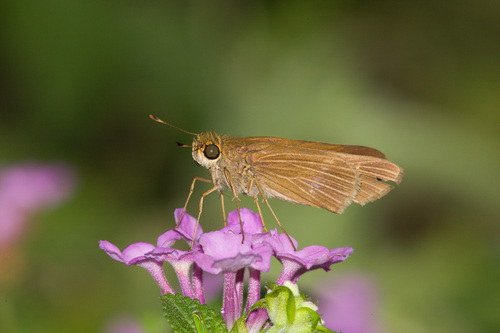
Ocola Skipper
Panoquina ocola
The Ocola Skipper is a master of high-speed maneuvers, easily identified by its exceptionally long wings and chocolate-brown palette. A late-season visitor to many backyards, this energetic traveler brings a touch of tropical speed to your garden.
Quick Identification
Size
Wingspan of 3.2–4.1 cm (1.25–1.6 inches)
Colors
Uniform dark chocolate brown; forewings feature small, translucent (hyaline) spots; hindwings are typically plain and unmarked.
Key Features
- Extremely long and narrow forewings compared to other skippers
- Plain brown hindwing with no spots or bands
- Rapid, darting flight pattern
- Resting posture with forewings held at a 45-degree angle
When You’ll See Them
Behavior
The Ocola Skipper is a powerhouse of the butterfly world, known for its rapid, erratic flight that makes it look like a tiny brown jet darting through the garden. Unlike many of its more colorful cousins, the Ocola relies on its incredible speed and aerodynamic 'long-wing' shape to navigate. It is a frequent visitor to flower patches but rarely stays in one spot for long, nectaring quickly before 'skipping' to the next blossom.
This species is a notable migrant. While it resides year-round in tropical climates and the Gulf Coast, it pushes northward in late summer and autumn, reaching as far as southern Canada in some years. In a backyard setting, they are often found in sun-drenched spots, utilizing their long proboscis to reach deep into tubular flowers that other insects might struggle to feed from.
EverydayEarth exclusive
Camera Tips
To capture the Ocola Skipper on your backyard camera, focus your lens on 'hotspot' nectar plants. This species is particularly fond of purple and pink blooms like Lantana, Zinnia, and Buddleia. Position your camera approximately 12 to 18 inches away from the flowers, aiming for a side-view angle. This profile shot is crucial for the AI to recognize the Ocola’s distinctive long forewings and the absence of spots on the hindwings, which distinguishes it from the more common Sachem or Fiery Skippers.
Because skippers are extremely fast and jittery, use a high-speed shutter or 'action' mode if your camera settings allow it. The Ocola Skipper often visits gardens during the warmest part of the day, so ensure your camera is positioned to avoid direct lens flare from the midday sun. Using a North-facing orientation for your camera setup often provides the most consistent, soft lighting on the wings without creating harsh shadows that obscure their subtle spots.
Consider setting up a 'puddling station' nearby—a shallow dish with damp sand and a few rocks. Ocola Skippers, like many butterflies, will land on moist soil to drink mineral-rich water. This provides a much more stable, stationary target for your camera compared to a swaying flower. Late August and September are the 'magic months' for this species in the United States, so keep your batteries charged and your storage clear during the late summer migration peak.
Similar Species
Species that look similar or are commonly confused with Ocola Skipper.
Long-tailed Skipper
The Long-tailed Skipper has unmistakable long 'tails' extending from its hindwings and an iridescent blue-green body.
Eufala Skipper
Eufala Skippers are smaller with shorter, more rounded wings and often have a grayer tone to their brown coloring.
Brazilian Skipper
Much larger than the Ocola, with more prominent translucent spots on the forewings and a distinct row of spots on the hindwings.
Frequently Asked Questions
Record Ocola Skipper at your habitat
Connect a camera to start building your own species record — AI identifies every visitor automatically.