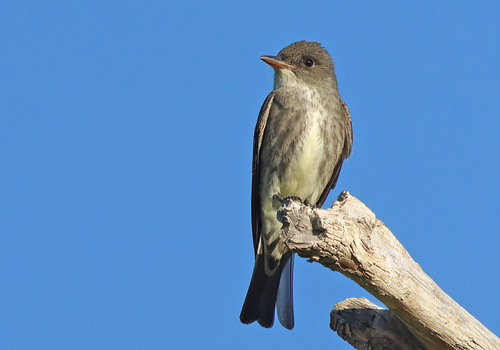
Olive-sided Flycatcher
Contopus cooperi
A champion of the high canopy, the Olive-sided Flycatcher is famous for its dapper 'vested' plumage and its ringing forest call. This migratory marvel brings a touch of wild mountain spirit to any backyard with tall evergreens.
Quick Identification
Size
Length: 18-20 cm (7-8 in); Wingspan: 31.5-34.5 cm (12-14 in); Weight: 28-37 g (1-1.3 oz)
Colors
Sooty brownish-gray upperparts; white throat, breast, and belly with dark olive-gray 'vested' sides; bill is dark with a pale base on the lower mandible.
Key Features
- Dark brownish-gray 'vested' appearance over a white underbelly
- Large, heavy bill with a hooked tip
- Frequent perching on the highest dead branches of tall trees
- White tufts occasionally visible on the sides of the rump
When You’ll See Them
Behavior
The Olive-sided Flycatcher is a master of the 'sallying' hunting technique. It spends much of its day perched conspicuously on the highest available snags or dead branches of tall conifers. From these vantage points, it scans the air for large flying insects, launching into acrobatic aerial pursuits before returning to the same branch or a nearby perch to eat its prize.
Highly territorial during the breeding season, these birds are known for their aggressive defense of their nesting sites, often chasing away much larger birds like hawks or ravens. Despite their bold defensive behavior, they are relatively solitary and are most easily located by their loud, distinctive three-note whistle, which birders often translate as 'Quick, three beers!'
EverydayEarth exclusive
Camera Tips
Capturing the Olive-sided Flycatcher requires a strategy focused on verticality. Unlike many backyard birds that visit low feeders or birdbaths, this species is a canopy specialist. To get a clear shot, mount your camera at a high vantage point—such as a second-story deck or a specialized high-reaching pole—directed toward the tips of the tallest dead trees or 'snags' in the area. These birds have a strong site fidelity for their favorite hunting perches, so if you see one landing on a specific branch, it is highly likely to return to that exact spot multiple times a day.
Because these birds are remarkably fast when they dive after insects, trigger speed is everything. Set your AI-powered camera to its highest sensitivity and use a 'Burst' or 'Photo + Video' mode. A trigger speed of 0.2 seconds or less is ideal to ensure you catch the bird before it launches. If your camera settings allow for it, prioritize a high shutter speed to freeze the motion of their rapid wingbeats during takeoff and landing.
Lighting can be a significant challenge since these birds often perch against a bright sky, which can lead to silhouetting. If possible, position your camera so the sun is behind it, illuminating the bird’s front to capture the detail of its characteristic 'vest.' In your camera’s software settings, look for an 'HDR' or 'Backlight' mode to help balance the exposure between the dark bird and the bright background. Avoid using traditional bird feeders as bait, as these birds only eat live, flying prey; however, maintaining a wildlife pond that attracts dragonflies and bees can naturally draw them into your camera’s field of view.
Similar Species
Species that look similar or are commonly confused with Olive-sided Flycatcher.
Frequently Asked Questions
Record Olive-sided Flycatcher at your habitat
Connect a camera to start building your own species record — AI identifies every visitor automatically.