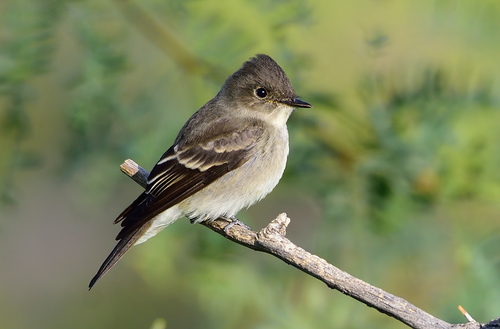
Western Wood-Pewee
Contopus sordidulus
The Western Wood-Pewee is the understated acrobat of the western skies, known for its persistent buzzing call and its remarkable ability to snatch insects out of thin air from high, lonely perches.
Quick Identification
Size
Length: 5.5-6.3 in (14-16 cm); Wingspan: 9.8-10.6 in (25-27 cm); Weight: 0.4-0.5 oz (12-15 g)
Colors
Dull grayish-olive upperparts, pale underparts with dusky washing on the sides and breast, dark crown, and two faint whitish wing bars.
Key Features
- Absence of a distinct eye-ring
- Very long wings that extend far down the tail when perched
- Dark upper mandible and a lower mandible that is usually yellowish at the base but dark at the tip
- Distinctive 'sallying' flight pattern from high, exposed branches
When You’ll See Them
Behavior
The Western Wood-Pewee is a master of the 'sit-and-wait' hunting strategy. You will typically see this bird perched upright on an exposed, dead branch high in the canopy. From this vantage point, it scans the air for passing insects, darting out in a quick, acrobatic loop to snatch prey before returning to the exact same spot. This behavior, known as 'hawking' or 'sallying,' makes them relatively easy to observe once you’ve located their preferred lookout.
These flycatchers are highly territorial during the breeding season and are more often heard than seen. Their nasal, buzzing call is a staple sound of western forests in the summer. While they aren't particularly shy around humans, they prefer the mid-to-upper levels of the tree canopy, meaning they rarely descend to the ground or low shrubs unless they are nesting or chasing a low-flying insect.
EverydayEarth exclusive
Camera Tips
To capture a Western Wood-Pewee on your backyard or trail camera, you need to look up. These birds are creatures of habit and will use the same 'launching pad' branch for days at a time. Identify a dead, horizontal branch with a clear flight path around it at a height of 10 to 20 feet. If you can safely mount a camera on a nearby trunk or pole angled toward this perch, you are almost guaranteed high-quality action shots of their takeoff and landing.
Because these birds are small and move incredibly fast during their hunting sorties, you must use a camera with a very fast trigger speed (0.2 seconds or less) and a high frame rate. Set your camera to 'Burst Mode' or 'Photo + Video' to capture the moment of the insect strike. Since they don't visit traditional bird feeders, you won't be able to bait them with seed, but maintaining a wildlife pond or birdbath can draw them down for a quick drink or dip during the heat of the afternoon.
Lighting is your biggest challenge when shooting into the canopy. Try to position your camera so the sun is behind it, illuminating the bird's underside; otherwise, you'll end up with a dark silhouette against a bright sky. In late summer, keep an eye on the edges of your property where forest meets open lawn, as these 'edge' zones are their favorite hunting grounds before they begin their southward migration in September.
Similar Species
Species that look similar or are commonly confused with Western Wood-Pewee.
Eastern Wood-Pewee
Nearly identical in appearance but found in the Eastern US; possesses a clearer, whistled three-part song.
Willow Flycatcher
Has a noticeable (though faint) eye-ring and shorter wings; prefers shrubby thickets near water rather than high canopy perches.
Olive-sided Flycatcher
Larger with a much heavier bill and distinctive 'vested' appearance with dark flanks and a white stripe down the center.
Frequently Asked Questions
Record Western Wood-Pewee at your habitat
Connect a camera to start building your own species record — AI identifies every visitor automatically.