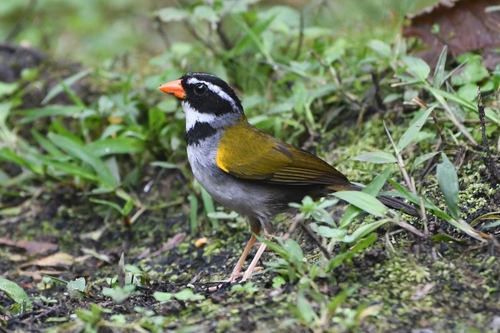
Orange-billed Sparrow
Arremon aurantiirostris
Meet the dapper ground-dweller of the tropics. With its neon-orange beak and striking tuxedo-like head stripes, the Orange-billed Sparrow brings a splash of color to the forest's deepest shadows.
Quick Identification
Size
5.7–6.5 inches (14.5–16.5 cm) in length; weight ranges from 1.0–1.2 oz (28–34 g)
Colors
A brilliant orange or orange-red bill; black head with white stripes on the crown and above the eyes; clean white throat; olive-green back and wings; greyish-white belly. Sexes are monomorphic (look alike).
Key Features
- Vibrant, heavy orange-to-red bill
- Bold black-and-white striped head pattern
- Bright white throat patch contrasting with a black 'bib'
- Prefers hopping on the ground rather than flying high in the canopy
When You’ll See Them
Behavior
The Orange-billed Sparrow is a quintessential ground-dweller of the tropical forest floor. Unlike many other sparrows that prefer open grasslands, this species thrives in the deep shade of the understory. They are most commonly seen in pairs or small family groups, moving through the leaf litter with a characteristic 'double-scratch' hop to uncover hidden insects and seeds. While they are relatively shy and prefer to stay near dense cover, they are not particularly fearful of humans if they feel protected by vegetation.
Their social behavior is largely territorial, especially during the breeding season. You will often hear them before you see them; their song is a series of high-pitched, thin whistles that cut through the humid forest air. When startled, they rarely fly long distances, preferring instead to scurry away into the thickets or low-hanging vines, making them a delightful challenge for backyard observers and trail camera enthusiasts alike.
EverydayEarth exclusive
Camera Tips
To capture the Orange-billed Sparrow, you must think like a ground-dweller. Placement is the most critical factor; mount your camera no higher than 6 to 12 inches off the ground. Aim the lens at a flat patch of forest floor or a natural clearing in the leaf litter. Because these birds spend almost all their time hopping under the canopy, a camera mounted at human eye level will likely only catch the top of their heads or miss them entirely as they move behind logs and low foliage.
Since these birds are attracted to the sound and movement of insects in the leaves, you can create a 'natural' lure by clearing a small 2-foot circle of debris and lightly tossing a handful of dried mealworms or high-quality cracked corn. Unlike many garden birds, they won't typically use hanging feeders, so ground-level stations are essential. If your backyard has a shaded corner with dense shrubbery, this is the ideal location to set up your observation point.
Lighting is your biggest technical challenge. Because this sparrow favors deep shade, your camera’s sensor will be pushed to its limits. Set your AI camera to its highest motion sensitivity to ensure it triggers the moment the bird hops into frame. If your camera allows for shutter speed adjustments, try to keep it fast to avoid blur, as their scratching motions are rapid and jerky. Using a camera with a high-quality infrared (IR) flash for early morning shots will help capture the white head stripes even in low-light conditions.
Finally, patience is key with this species. They follow established foraging routes, so if you see one on your camera once, it is highly likely to return to that exact spot at the same time the following day. Look for areas where the soil is moist, as they prefer these spots for the abundance of invertebrates found there. Keep your camera housing clean and free of spider webs, as low-mounted gear is prone to gathering forest debris.
Similar Species
Species that look similar or are commonly confused with Orange-billed Sparrow.
Frequently Asked Questions
Record Orange-billed Sparrow at your habitat
Connect a camera to start building your own species record — AI identifies every visitor automatically.