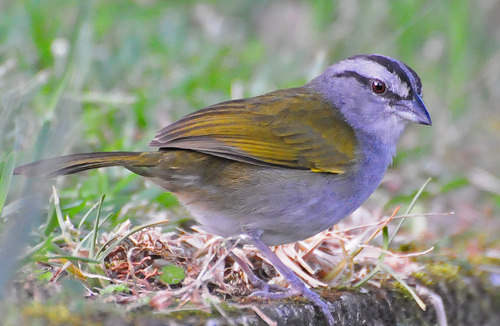
Black-striped Sparrow
Arremonops conirostris
A bold ground-dweller of the tropical edges, the Black-striped Sparrow is easily recognized by its striking 'racing stripes' and persistent scratching in the leaf litter.
Quick Identification
Size
16.5-19 cm (6.5-7.5 inches) in length; weighs approximately 30-40g (1.1-1.4 oz)
Colors
Grey head with thick black lateral crown stripes and eye stripes; olive-green back and wings; pale grey to white underparts; yellow 'shoulder' at the bend of the wing
Key Features
- Bold black and grey striped head pattern
- Large, heavy black conical bill
- Dull olive-green upperparts with no wing bars
- Distinctive yellow feathers at the bend of the wing
When You’ll See Them
Geographic range
Where Does the Black-striped Sparrow Live?
The Black-striped Sparrow is a native resident of the Neotropical regions of Central and South America. Its range begins in eastern Honduras and extends southward through Nicaragua, Costa Rica, and Panama into the northern reaches of South America. Within the southern continent, it is widely distributed across Colombia, Venezuela, western Ecuador, and into northern Brazil, thriving primarily in humid lowland environments where forest meets open land.
Basemap © OpenStreetMap contributors
Behavior
The Black-striped Sparrow is a quintessential ground-dweller of the Neotropics, known for its busy and methodical foraging habits. These birds are most often encountered in pairs or small family groups, hopping through leaf litter or low thickets. Unlike many forest birds that remain hidden, this sparrow is relatively bold and will often forage in the open near the safety of dense shrubs, making it a frequent visitor to gardens and edges of clearings.
Socially, they are monogamous and highly territorial, especially during the breeding season. Their song is a notable part of the morning chorus in their range—a series of deliberate, metallic whistles that accelerate into a trill. While they spend much of their time on the ground, they will fly to a low or mid-level perch to deliver their song or to investigate a perceived intruder in their territory.
EverydayEarth exclusive
Camera Tips
To capture the Black-striped Sparrow on your AI-powered camera, ground placement is essential. These birds rarely venture high into the canopy, spending the vast majority of their time within two feet of the forest floor. Mount your camera on a short stake or a low tree trunk, angled slightly downward to focus on a patch of open leaf litter or a flat rock where you can scatter attractants. A height of 6 to 12 inches off the ground is ideal for eye-level shots of their striking head patterns.
Because these sparrows are constant 'scratchers'—using their feet to kick back leaves and debris to find insects—they move in quick, jerky motions. To avoid blurry images, set your camera to a fast trigger speed and utilize a 'burst' or 'multi-shot' mode. This increases your chances of catching a still moment between scratches. High-sensitivity motion settings are recommended since their small size and dull green backs can sometimes blend into the background shadows, potentially failing to trigger less sensitive sensors.
Baiting is highly effective for this species. A handful of cracked corn, sunflower hearts, or even chopped tropical fruits like papaya placed in front of the lens will keep them in the frame for several minutes. They are creatures of habit, so if you find a spot they like, they are likely to return to it at the same time every morning. Look for areas near brush piles or dense hedges, as they prefer to have a quick escape route nearby.
Lastly, pay attention to the lighting. Because they inhabit 'edge' environments, the light can be patchy and harsh. Positioning your camera so the sun is behind it (facing north or south depending on your latitude) will help illuminate the subtle yellow patch on their wings and the sharp contrast of their facial stripes without causing the lens flare associated with direct tropical sunlight.
Similar Species
Species that look similar or are commonly confused with Black-striped Sparrow.
Olive Sparrow
Smaller with much paler, duller brown-grey head stripes and a lighter bill; found more commonly in Mexico and Texas.
Green-backed Sparrow
Very similar but has a brighter green back and a more distinct white throat; found in the Yucatan and parts of Central America.
Orange-billed Sparrow
Easily distinguished by its bright orange bill and more uniform grey head without the heavy black striping.
Frequently Asked Questions
Record Black-striped Sparrow at your habitat
Connect a camera to start building your own species record — AI identifies every visitor automatically.