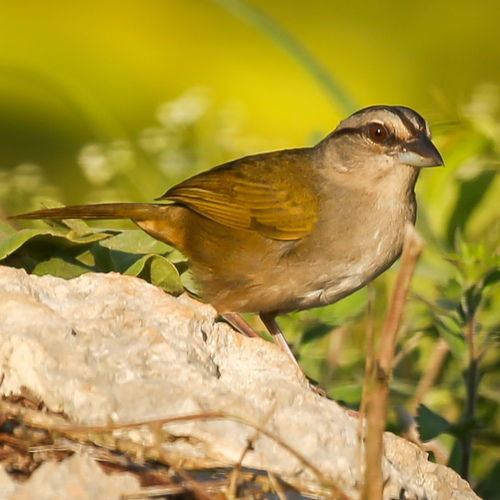
Green-backed Sparrow
Arremonops chloronotus
A master of the undergrowth, the Green-backed Sparrow adds a splash of olive-green and a rhythmic song to Central American gardens. Its bold head stripes and secretive nature make it a rewarding find for patient backyard observers.
Quick Identification
Size
14-15 cm (5.5-6 inches) in length; weighs approximately 22-28 g (0.8-1.0 oz)
Colors
Olive-green back and wings; gray head with thick black lateral stripes; white supercilium (eyebrow); pale gray to white underparts. Sexes are monomorphic.
Key Features
- Bold black and gray striped crown
- Uniform olive-green upperparts without wing bars
- Ground-dwelling habit with frequent hopping
- Relatively heavy, dark conical bill
When You’ll See Them
Geographic range
Where Does the Green-backed Sparrow Live?
The Green-backed Sparrow is a characteristic species of northern Central America and southern Mexico. It is native to the Yucatan Peninsula and extends southward through the lowland regions of Belize, northern Guatemala, and into western Honduras. Within this range, it thrives in both pristine tropical forests and heavily degraded secondary growth, provided there is enough dense scrub for nesting and protection.
Basemap © OpenStreetMap contributors
Behavior
The Green-backed Sparrow is a shy and somewhat secretive inhabitant of the understory. Unlike more gregarious sparrow species, it is typically found in pairs or small family units, spending the majority of its time scratching through leaf litter for food. While they are often difficult to spot in the dense foliage, their presence is frequently announced by a distinctive song—a series of dry chips that accelerate into a rapid trill.
In human-modified landscapes, they are cautious but can become habitual visitors to quiet backyards that offer plenty of 'wild' edges. They are not known for long-distance flights, preferring to move through the brush with short, low bursts or by hopping between low branches. Their social interactions are mostly limited to their mate, with whom they maintain a year-round territory.
EverydayEarth exclusive
Camera Tips
To successfully capture a Green-backed Sparrow on camera, ground-level placement is essential. These birds rarely venture more than a few feet off the ground, so position your camera 6-12 inches above the soil, aimed at a patch of leaf litter or the edge of a dense thicket. Use a wide-angle lens if possible, as they tend to forage very close to cover.
You can encourage them to linger in front of the lens by creating a 'foraging station.' Instead of an elevated feeder, scatter small seeds like white proso millet or finely cracked corn directly on the ground near a brush pile. They are particularly attracted to areas where they can scratch; if your soil is hard, loosening it and mixing in some birdseed can trigger their natural instinct to forage in that specific spot.
Water is an incredible lure for this species. A low-profile birdbath or even a shallow saucer of water placed in a shaded area will attract them for daily drinking and bathing. Ensure the water is near cover so they feel safe approaching. Because they are shy, set your camera to a high sensitivity and use a fast shutter speed or high-frame-rate video to catch their quick, nervous movements without blur.
Avoid placing the camera in bright, open sunlight. These birds prefer the dappled light of the forest floor or garden edges. Shadows help them feel secure and also prevent the high-contrast 'blown out' highlights that can happen with their pale underparts in direct tropical sun. Early morning is the best time for lighting and activity.
Similar Species
Species that look similar or are commonly confused with Green-backed Sparrow.
Frequently Asked Questions
Record Green-backed Sparrow at your habitat
Connect a camera to start building your own species record — AI identifies every visitor automatically.