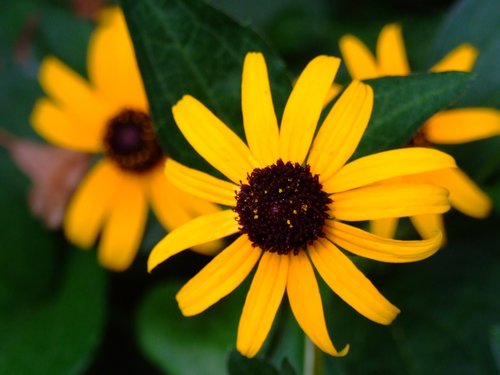
orange coneflower
Rudbeckia fulgida
A golden icon of the American prairie, the orange coneflower is a resilient perennial that brings vibrant color and a frenzy of pollinator activity to any backyard garden.
Quick Identification
Size
Stands 60–90 cm (24–36 inches) tall with a spread of 60 cm (24 inches)
Colors
Brilliant golden-orange ray petals with a dark chocolate-brown or black central cone; foliage is a deep, matte green.
Key Features
- Daisy-like flowers with 10-20 golden-orange petals
- Raised, dark brown central disk (the 'cone')
- Coarse, lance-shaped leaves with distinct veins
- Clump-forming growth habit with stiff, upright stems
When You’ll See Them
Geographic range
Where Does the orange coneflower Live?
Native to the North American continent, the orange coneflower is primarily found throughout the eastern and central United States. Its core range extends from Connecticut and New York southward into Florida, reaching as far west as Texas, Oklahoma, and Michigan. While it is native to these regions, it has been widely naturalized in suburban landscapes across the Pacific Northwest and parts of Canada due to its popularity as a garden staple.
Basemap © OpenStreetMap contributors
Behavior
The orange coneflower is a hardy, clump-forming perennial known for its long-lasting summer and autumn blooms. Unlike its biennial relatives, it spreads slowly through rhizomes to create dense patches of color that can persist for many years in the same location. It is a heliophilic species, meaning it thrives in full sun and will often tilt its flower heads to track the movement of the sun throughout the day.
This species is a powerhouse for local ecosystems, serving as a primary nectar source for a vast array of pollinators including honeybees, bumblebees, and various butterfly species like the Pearl Crescent. In the winter, the dried seed heads remain upright, providing a critical food source for small songbirds and offering structural interest in a dormant garden.
EverydayEarth exclusive
Camera Tips
Capturing the orange coneflower on a backyard camera is less about the plant itself and more about the incredible 'pollinator highway' it creates. To get the best shots, mount your camera on a small tripod or garden stake roughly 12-18 inches from a cluster of blooms. Angle the lens slightly downward to capture the contrast between the dark central cones and the bright petals. If you are using an AI-powered camera, set it to a high-sensitivity motion trigger to capture the rapid movement of bees and butterflies that frequent the blossoms during the peak afternoon heat.
For those interested in the growth of the plant, time-lapse mode is highly recommended. Set your camera to take a photo every 30 minutes from late June through August. This will allow you to see the spectacular transition from tight green buds to the iconic golden explosions of color. Ensure your camera is positioned to the south of the plant so that the sun stays behind the lens, preventing lens flare and ensuring the colors of the petals are deeply saturated in your footage.
In the autumn and winter months, do not take your camera down. Position the camera to face the dried, darkened seed heads. This is the best time to capture footage of American Goldfinches and other small birds as they cling to the stems to feast on the seeds. Use a faster shutter speed if your camera allows it, as bird movements are much more sporadic and quick than the slow sway of the flowers in the wind. If the area is windy, consider using a physical stabilizer for the plant stem just out of the frame to keep the flower head from blurring in the shot.
Similar Species
Species that look similar or are commonly confused with orange coneflower.
Frequently Asked Questions
Record orange coneflower at your habitat
Connect a camera to start building your own species record — AI identifies every visitor automatically.