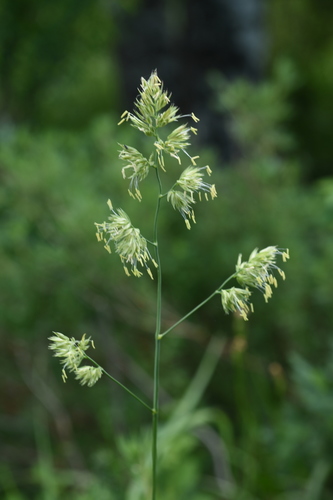
orchard grass
Dactylis glomerata
A hardy, clump-forming perennial known for its distinctive 'cock's-foot' seed heads and its status as a favorite snack for local wildlife and domestic cats alike.
Quick Identification
Size
Stems typically reach 30–140 cm (12–55 inches) in height; leaf blades are 10–45 cm (4–18 inches) long.
Colors
Bluish-green to gray-green foliage; flower heads are pale green to purplish, turning golden-straw colored when mature.
Key Features
- Distinctive 'cock’s foot' branched seed heads with dense clusters
- Tufted, clump-forming growth habit rather than spreading by runners
- Flattened leaf sheaths at the base of the plant
- Prominent, white membranous ligule where the leaf meets the stem
When You’ll See Them
Behavior
Orchard grass is a hardy, cool-season perennial that earns its name from its historical use as a shade-tolerant forage in orchards. Unlike many lawn grasses that spread via underground runners, orchard grass grows in dense, stubborn tufts or hummocks. It is one of the first grasses to turn green in the spring and continues to grow vigorously until the heat of midsummer, when it may go semi-dormant before a second growth spurt in autumn.
In a backyard ecosystem, orchard grass acts as a vital foundation. It serves as a host plant for various butterfly larvae, such as the Zabulon Skipper, and its dense clumps provide essential nesting cover for small mammals and ground-nesting birds. For humans, it is perhaps most famous as 'cat grass'; domestic cats are frequently seen nibbling on its blades to aid their digestion, a behavior mirrored by wild canids and felids.
EverydayEarth exclusive
Camera Tips
When capturing orchard grass with your AI-powered camera, think of the grass as both a subject and a stage. Because this grass grows in distinct tufts, it creates excellent 'alleys' for wildlife. Position your camera at a low 'worm's-eye' view, roughly 4 to 6 inches off the ground, angled slightly upward. This captures the architectural beauty of the seed heads against the sky and puts you at the right level to see small rodents or birds moving through the clumps.
Be mindful of the wind. Orchard grass has long, flexible stems that sway significantly. To avoid a flood of 'false positive' triggers on your camera, use a 'Zone Detection' feature to exclude the tops of the grass if your goal is to capture animals. However, if you want to capture the grass itself, a time-lapse setting is your best friend. Set your camera to take a photo every hour during the spring growth spurt to watch the seed heads unfurl over several weeks.
Orchard grass is a natural lure for herbivores. If you want to see deer, rabbits, or even neighborhood cats, place your camera near a particularly lush, green patch of this grass. You don't need artificial bait; the high protein content of the young shoots is enough to attract 'backyard regulars.' For the best lighting, aim for 'Golden Hour' (the hour after sunrise or before sunset), which illuminates the fine hairs and pollen on the flower clusters, creating a glowing effect on film.
Similar Species
Species that look similar or are commonly confused with orchard grass.
Frequently Asked Questions
Record orchard grass at your habitat
Connect a camera to start building your own species record — AI identifies every visitor automatically.