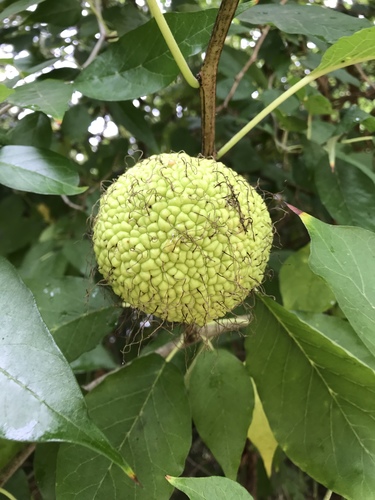
Osage-orange
Maclura pomifera
A living relic of the Ice Age, the Osage-orange is famous for its 'hedge apple' fruit and its history as nature's barbed wire. Its thorny branches provide a secure fortress for backyard birds and a playground for industrious squirrels.
Quick Identification
Size
Grows 8–15 m (30–50 ft) tall; fruit 8–15 cm (3–6 in) in diameter; trunk 30–90 cm (1–3 ft) wide.
Colors
Glossy dark green leaves; bright lime-green bumpy fruit; orange-brown deeply furrowed bark.
Key Features
- Large, bumpy, lime-green 'hedge apple' fruit
- Sharp, stout thorns on younger branches
- Milky white, sticky latex sap in fruit and stems
- Interlocking, dense canopy with orange-tinted inner bark
When You’ll See Them
Geographic range
Where Does the Osage-orange Live?
The Osage-orange is native to a specific region of North America, historically concentrated in the Red River Valley drainage of Texas, Oklahoma, and Arkansas. Due to its popularity as a windbreak and 'living fence' during the 19th century, it has been widely introduced and naturalized across most of the contiguous United States and parts of southern Canada. Beyond North America, the species has been successfully established in parts of Europe and Asia, where it is valued for its hardiness and soil-binding roots in erosion-prone areas.
Basemap © OpenStreetMap contributors
Behavior
The Osage-orange is a resilient and fast-growing deciduous tree, famously known for its role in American agricultural history. Before the invention of barbed wire, settlers planted these trees in dense rows to create 'living fences.' When pruned heavily, the tree's interlocking, thorny branches grew so thick they were said to be 'horse-high, bull-strong, and hog-tight,' effectively containing livestock and marking property boundaries.
As a dioecious species, the Osage-orange has distinct male and female individuals. While both grow thorns and glossy foliage, only the female trees produce the heavy, brain-like fruit in the autumn. Although the fruit is largely ignored by modern large mammals, the tree remains a hub of activity for smaller wildlife. Its dense, prickly structure provides an impenetrable fortress for nesting birds and small mammals seeking refuge from predators like hawks or cats.
EverydayEarth exclusive
Camera Tips
To capture the wildlife attracted to an Osage-orange, the best strategy is to focus on the fallen fruit during the autumn months. Place your camera on a short tripod or mount it to a nearby fence post about 12 to 18 inches off the ground. Point the lens at a cluster of 'hedge apples' on the ground. Squirrels and chipmunks are the primary visitors, as they will spend considerable time gnawing through the tough, bumpy exterior to reach the seeds inside, providing excellent foraging footage.
If you are looking for birds, utilize the tree's thorny architecture. Place your camera near the mid-section of the canopy if possible, or along the edge of a 'hedgerow' of these trees. Many songbirds, such as Northern Cardinals and Brown Thrashers, use the thorns as protection. A camera with a fast trigger speed is essential here to catch birds darting in and out of the dense cover. In winter, the bark of young Osage-orange trees is a food source for rabbits; aiming your camera at the base of the trunk during snowy periods can yield great results.
Because the Osage-orange is often planted in straight lines (hedgerows), these trees act as natural highways for larger mammals. Set your trail camera to 'Video Mode' and place it parallel to a line of these trees to capture White-tailed Deer, Coyotes, or Foxes as they travel along the sheltered edge of the field. The bright green of the fruit can sometimes overexpose in direct midday sun, so try to position your camera facing North or South to maintain consistent lighting throughout the day.
Similar Species
Species that look similar or are commonly confused with Osage-orange.
Frequently Asked Questions
Record Osage-orange at your habitat
Connect a camera to start building your own species record — AI identifies every visitor automatically.