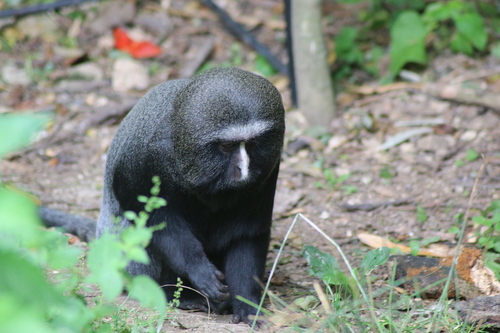
Owl-faced Guenon
Cercopithecus hamlyni
A striking primate with a face unlike any other, the Owl-faced Guenon is a ghost of the Congo’s deep bamboo forests. With its distinct white facial stripe and elusive nature, catching one on camera is a rare prize for any wildlife enthusiast.
Quick Identification
Size
Body length of 50-65 cm (20-26 in) with a tail of 45-60 cm (18-24 in); weighs between 4-10 kg (9-22 lbs).
Colors
Dark grey to blackish fur with olive-green speckling; prominent vertical white stripe on the nose; males often exhibit a bright blue scrotum.
Key Features
- Vertical white stripe from forehead to upper lip
- Large, forward-facing eyes giving an owl-like appearance
- Long, dark tail and slender limbs
- Dark greyish-black coat with yellowish-olive ticking
When You’ll See Them
Behavior
The Owl-faced Guenon is one of Africa’s most mysterious primates, characterized by its quiet and secretive lifestyle. Unlike more common monkeys that leap through the high canopy, these guenons are largely terrestrial, preferring to travel along the forest floor or through dense bamboo thickets. This ground-dwelling habit, combined with their dark coloration, makes them incredibly difficult to spot in the dense jungle undergrowth.
They typically live in small, close-knit family units usually consisting of one dominant male and multiple females. Their social interactions are subtle, often involving low-frequency vocalizations that do not travel far, which likely helps them avoid detection by predators like leopards or eagles. While they are generally shy and avoid human contact, they are known for their slow, deliberate movements that set them apart from the more frantic energy of other Old World monkeys.
EverydayEarth exclusive
Camera Tips
Because Owl-faced Guenons are largely terrestrial and likely active during the dim hours of twilight, trail camera placement is your most important factor. Position your camera low to the ground—ideally between 12 and 18 inches high—to capture them at eye level as they move along forest trails. Angling the camera slightly upward can help ensure you capture the distinctive vertical white nose stripe, which is their most defining feature in a photo.
Standard motion triggers can sometimes be too slow for cautious primates that pause frequently. Set your camera to its fastest possible trigger speed and use a high-sensitivity PIR (passive infrared) setting. Since there is strong evidence they are crepuscular or even nocturnal, it is vital to use a camera equipped with 'No-Glow' black infrared LEDs. Standard 'Low-Glow' LEDs emit a faint red light that can startle these shy animals, causing them to avoid the area in the future.
We recommend using video mode rather than still photos. A 20-second video clip allows you to see the animal's unique quadrupedal gait and hear any low-frequency vocalizations. If you are placing a camera in a known habitat, look for natural 'funnels' like gaps in bamboo thickets or paths near fallen fruit trees. Avoid using artificial food lures, as these can disrupt their natural foraging patterns; instead, focus on areas with fresh bamboo shoots or clear animal tracks in the mud.
Check your camera settings to ensure the 'Recovery Time' is set to the minimum. Owl-faced Guenons often travel in small groups, and a long delay between recordings might mean you capture the lead male but miss the females and juveniles following behind. If your camera supports it, a dual-lens system optimized for both day and night will provide the crispest images of their subtle facial markings.
Similar Species
Species that look similar or are commonly confused with Owl-faced Guenon.
L'Hoest's Monkey
L'Hoest's has a prominent white 'ruff' or beard around its neck, whereas the Owl-faced Guenon is distinguished by the vertical white stripe down its nose.
Blue Monkey
Blue monkeys are more arboreal and lack the specific 'owl-like' vertical facial stripe, typically showing a more uniform dark grey face.
Frequently Asked Questions
Record Owl-faced Guenon at your habitat
Connect a camera to start building your own species record — AI identifies every visitor automatically.