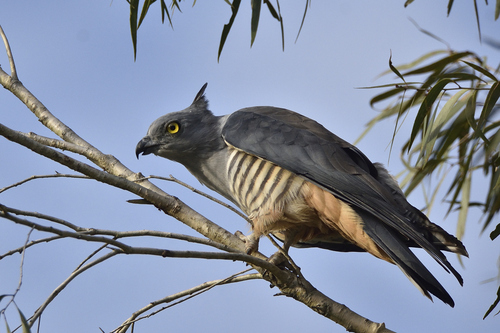
Pacific Baza
Aviceda subcristata
Meet the 'Crested Hawk' of the canopy, a master of aerial acrobatics and stealthy foraging. With its striking barred belly and bright yellow eyes, the Pacific Baza is a charismatic visitor to leafy backyards and tropical forests alike.
Quick Identification
Size
Length: 35–46 cm (14–18 in); Wingspan: 80–105 cm (31–41 in); Weight: 260–450 g (9–16 oz)
Colors
Pale grey head, neck, and breast; slate-grey to brown upperparts; distinctive bold dark-brown or black horizontal barring on a white belly; bright yellow eyes; greyish-black bill; and a small, pointed grey crest.
Key Features
- Prominent small, pointed crest on the back of the head
- Bold horizontal 'zebra' barring on the underparts
- Bright, piercing yellow irises
- Broad, paddle-shaped wings with rounded tips in flight
- Relatively small, hooked hawk-like beak
When You’ll See Them
Geographic range
Where Does the Pacific Baza Live?
The Pacific Baza is native to the lush regions of Australasia and the Indo-Pacific. Its core range extends from the northern and eastern coastal regions of Australia—stretching from the Kimberley across the Top End to the central coast of New South Wales—up through Papua New Guinea and the Solomon Islands. It is also commonly found across the eastern islands of Indonesia and East Timor, favoring tropical and subtropical zones where tall timber is abundant.
Basemap © OpenStreetMap contributors
Behavior
The Pacific Baza is an exceptionally graceful and acrobatic raptor, often described as more 'playful' than its hawk relatives. They are famous for their spectacular courtship displays, which involve high-altitude somersaults, tumbling dives, and rolling maneuvers through the air, usually accompanied by a distinctive two-note whistling call. Unlike many other birds of prey that hunt from high soaring positions, Bazas prefer to move through the mid-to-high canopy with a unique 'leaping' flight style, hopping from branch to branch.
Social and relatively docile, these birds are often seen in pairs or family groups outside of the breeding season. They are canopy specialists, frequently seen hanging upside down from thin outer branches to snatch insects or frogs from the underside of leaves. Despite being raptors, they are not particularly shy and have adapted well to leafy suburban environments where mature native trees provide both cover and food.
EverydayEarth exclusive
Camera Tips
To capture a Pacific Baza on an AI-powered camera, you must focus on the vertical landscape. Because they are canopy dwellers, ground-level camera traps will rarely see them. Mount your camera 4 to 8 meters high in a mature tree, preferably one with horizontal, open limbs that offer a clear view of the surrounding canopy. Look for 'whitewash' (droppings) on branches or the ground, which indicates a regular perching spot. Angle your camera slightly downward to capture them as they land to scan for prey.
While you cannot lure them with traditional bird feeders, you can attract them by creating a 'Baza-friendly' ecosystem. Dense native plantings that host large insects like stick insects or provide habitat for tree frogs are natural magnets. If you have a high birdbath or a water feature, ensure it has a clear flight path; Bazas will occasionally descend for a midday bath or drink, particularly during the humid summer months between 11 AM and 2 PM.
Use high-speed trigger settings and burst photo modes. Their movements within the canopy—especially when hanging upside down to forage—are quick and unpredictable. If your camera supports high-resolution video, use it to capture their unique 'leaping' flight between branches. During the breeding season from September to February, a camera pointed at a persistent gap in the forest canopy may catch their spectacular tumbling aerial displays.
Similar Species
Species that look similar or are commonly confused with Pacific Baza.
Frequently Asked Questions
Record Pacific Baza at your habitat
Connect a camera to start building your own species record — AI identifies every visitor automatically.