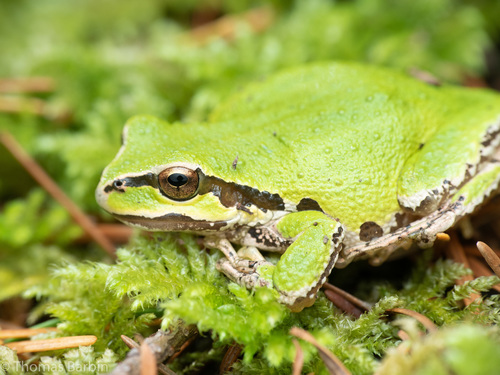
Pacific chorus frog
Pseudacris regilla
The quintessential 'voice of the West,' this tiny climber is famous for its Hollywood-standard 'rib-bit' call and its remarkable ability to change color to match its surroundings.
Quick Identification
Size
0.75 to 2 inches (1.9 to 5 cm) in length; weighs approximately 0.1 to 0.3 ounces (3 to 8 grams)
Colors
Highly variable shades of bright green, tan, reddish, or dark brown; typically features a distinct dark 'mask' or stripe through the eye; cream-colored belly.
Key Features
- Dark 'mask' stripe running from the snout through the eye to the shoulder
- Large, rounded toe pads for climbing vertical surfaces
- Skin can change color from light to dark over several hours
- Small, slender body with a slightly pointed snout
When You’ll See Them
Behavior
Despite their small stature, Pacific chorus frogs are best known for their incredibly loud 'rib-bit' vocalizations. This specific sound is so iconic that it has become the standard frog sound in Hollywood films, regardless of where the movie is set. During the breeding season, males congregate near water sources to sing in a synchronized chorus that can be heard from nearly a mile away. They are remarkably agile, using their sticky toe pads to climb up windows, walls, and garden foliage.
These frogs are masters of camouflage, capable of shifting their skin color from vibrant green to dull brown to better blend into their surroundings. They are generally shy and will stop calling immediately if they detect a large vibration or a predator nearby. In a backyard setting, they are beneficial neighbors, acting as a natural pest control system by consuming large quantities of small insects.
EverydayEarth exclusive
Camera Tips
Capturing the Pacific chorus frog on camera requires a bit of strategy because their small size and cold-blooded nature often fail to trigger standard Passive Infrared (PIR) sensors. To combat this, set your camera to 'Time-Lapse' mode or 'Hybrid' mode with short intervals (every 1-5 minutes) during their peak active hours at night. If your camera allows for sensitivity adjustments, set the PIR to 'High' to increase the chances of detecting their slight movements.
For the best framing, place your camera low to the ground, no more than 6-12 inches high. Angle the lens toward a specific 'calling site'—usually a flat rock, a floating log, or the edge of a backyard pond where males like to perch. If you don't have a pond, a simple birdbath or even a shallow dish of dechlorinated water can act as a magnet for these moisture-loving amphibians. Aim for a focus distance of about 3 to 5 feet to ensure the tiny frog fills enough of the frame to be visible.
Nighttime lighting is critical. These frogs have moist, reflective skin that can easily be 'blown out' or overexposed by powerful infrared flashes at close range. If your camera has an adjustable flash, turn it to a lower power setting. Alternatively, you can place a small piece of semi-transparent tape over a portion of the flash to diffuse the light for a softer, more natural look. During the rainy season, ensure your camera has a protective hood or is angled slightly downward to prevent water droplets on the lens from obscuring your view of these tiny climbers.
Similar Species
Species that look similar or are commonly confused with Pacific chorus frog.
Frequently Asked Questions
Record Pacific chorus frog at your habitat
Connect a camera to start building your own species record — AI identifies every visitor automatically.