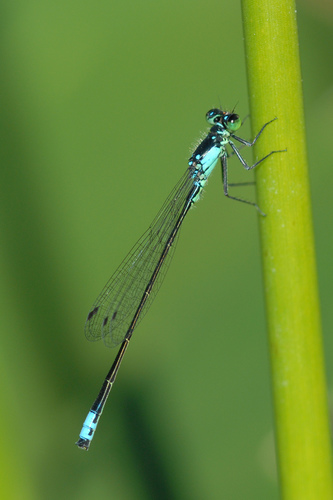
Pacific Forktail
Ischnura cervula
A tiny, electric-blue marvel of the western wetlands, the Pacific Forktail is the perfect subject for macro-wildlife enthusiasts. Watch for its signature four-spotted thorax as it dances through the reeds of your garden pond.
Quick Identification
Size
21–29 mm (0.8–1.1 inches) in length; wingspan of approximately 30–35 mm (1.2–1.4 inches)
Colors
Males are black with four distinct blue spots on the thorax and a bright blue segment near the tip of the abdomen. Females are polymorphic, appearing either light brown/orange or grey-green.
Key Features
- Four small blue spots on the top of the thorax
- Bright blue segment (S8) near the end of a black abdomen
- Large, widely separated eyes with blue postocular spots
- Slender, needle-like body shape
When You’ll See Them
Behavior
The Pacific Forktail is a delicate but active damselfly frequently seen hovering just inches above the surface of still water or perched on low-lying vegetation. Unlike their larger dragonfly cousins, forktails are relatively weak fliers and prefer to stay within the protection of reeds and grasses to avoid wind and predators. They are highly territorial over small patches of habitat, often engaging in miniature aerial skirmishes with other males.
These insects are sophisticated hunters of the undergrowth, using their serrated legs to snatch even smaller insects from the air. When not hunting, they spend significant time 'obelisking'—positioning their bodies to regulate temperature. In backyards, they are often the first damselflies to colonize a new garden pond or water feature, provided there is enough emergent vegetation for them to rest upon.
EverydayEarth exclusive
Camera Tips
To capture the Pacific Forktail on camera, you must focus on 'micro-habitats.' These damselflies are small and easily lost in a wide frame. Use a camera with a dedicated macro lens or a close-up AI camera positioned no further than 12-18 inches from a likely perching spot. Look for vertical stems or flat leaves that receive direct morning sunlight, as forktails use these spots to warm up their flight muscles before hunting.
Setting up your camera near the edge of a garden pond is ideal. Look for 'perch points'—dead twigs or reeds that stand taller than the surrounding grass. The Pacific Forktail is a creature of habit and will often return to the exact same perch dozens of times a day. By focusing your camera on one of these prominent stems, you can trigger high-resolution captures every time the insect lands to scan for prey.
Lighting is critical for showing off their iridescent blue markings. Position your camera so it is side-lit or slightly back-lit during the golden hours. This emphasizes the translucency of their four wings and makes the blue 'tail light' segment on the males pop against the background. Because they move their wings so rapidly, a shutter speed of at least 1/1000th of a second (or a high-speed video mode) is recommended to freeze the action without blur.
If you are using a trail camera with AI triggers, set the sensitivity to high. Since these insects are small, they may not trigger sensors designed for mammals. Place a dark, non-reflective background (like a dark green shrub or a piece of slate) a few feet behind the perch to help the AI isolate the subject and create a professional-looking 'bokeh' effect that makes the delicate blue spots of the Pacific Forktail clearly visible.
Similar Species
Species that look similar or are commonly confused with Pacific Forktail.
Western Forktail
The Western Forktail is slightly smaller and the male has solid blue stripes on its thorax instead of the four distinct blue spots.
Boreal Bluet
Bluets are generally larger with more extensive blue banding along the entire length of the abdomen, whereas the Pacific Forktail is mostly black with a blue tip.
Frequently Asked Questions
Record Pacific Forktail at your habitat
Connect a camera to start building your own species record — AI identifies every visitor automatically.