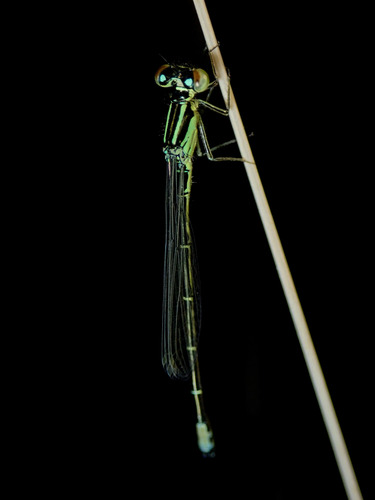
Western Forktail
Ischnura perparva
The Western Forktail is a miniature marvel of the backyard pond, sporting a brilliant green thorax and an electric-blue 'tail light.' Though tiny, these delicate damselflies are expert hunters that bring a splash of neon color to the water's edge.
Quick Identification
Size
Total length 21–29 mm (0.8–1.1 inches); wingspan approximately 30–35 mm (1.2–1.4 inches)
Colors
Males are bright lime-green on the thorax with black stripes and a black abdomen tipped with a bright blue segment 8. Females are polymorphic, appearing either as bright orange (immatures) or olive-tan (mature).
Key Features
- Bright lime-green thorax with black dorsal stripes
- Vibrant blue 'tail light' on abdominal segment 8 in males
- Diminutive size, often under one inch long
- Females transition from bright orange to cryptic olive-brown
When You’ll See Them
Behavior
The Western Forktail is one of the smallest and most delicate damselflies found in North America. Unlike the larger, high-flying dragonflies, these 'forkies' prefer to stay low to the ground, skillfully navigating through thickets of tall grass, sedges, and rushes near the water's edge. They are relatively weak fliers, typically moving in short, jerky bursts from one perch to another to stay out of the wind and avoid larger aerial predators.
These damselflies are highly effective 'gleaners.' While many Odonates catch their prey in mid-air, the Western Forktail often hunts by hovering near vegetation and plucking tiny, soft-bodied insects like aphids or gnats directly off of leaves. They are generally solitary but can be found in high densities around healthy backyard ponds where the habitat supports their specific breeding and hunting needs.
EverydayEarth exclusive
Camera Tips
Capturing the Western Forktail on camera is a rewarding challenge due to their tiny size. Standard trail cameras usually have a minimum focus distance that is too long for these insects. To get a clear shot, use a camera with macro capabilities or a dedicated macro lens for your backyard setup. Position the camera very low—between 6 and 12 inches off the ground—facing a cluster of vertical reeds or tall grasses where they are likely to perch.
Because these damselflies are too small to trigger the Passive Infrared (PIR) sensors found on most trail cameras, you must use a 'Time Lapse' mode. Set your camera to take a photo every 30 to 60 seconds during the peak heat of the day, usually from 11 AM to 3 PM. This is when the Western Forktail is most active, sunning itself to regulate its body temperature. High-resolution video settings can also work well if you can leave the camera recording for short intervals near a popular perching spot.
To increase your chances of a 'hero shot,' place a few clean, vertical bamboo stakes or natural dry reeds in a sunny, wind-sheltered spot near your water feature. These act as natural 'studio' perches. If the sun is at your back when the camera is positioned, you will capture the brilliant lime-green of the male's thorax and the metallic sheen of their wings. Avoid using sprays or chemicals in the area, as these insects are highly sensitive to water quality and environmental pollutants.
Similar Species
Species that look similar or are commonly confused with Western Forktail.
Frequently Asked Questions
Record Western Forktail at your habitat
Connect a camera to start building your own species record — AI identifies every visitor automatically.