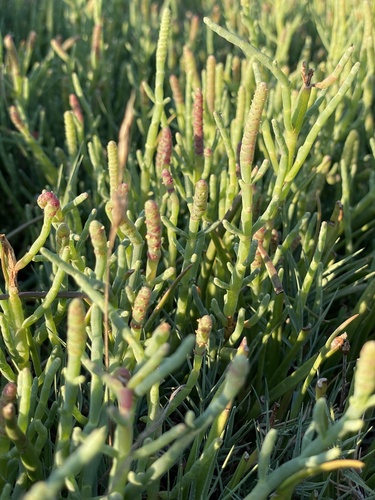
Pacific Glasswort
Salicornia pacifica
The resilient sentinel of the salt marsh, Pacific Glasswort paints the coastline in shades of emerald and fire. This extraordinary succulent thrives where the land meets the sea, providing a vital sanctuary for the Pacific's rarest wildlife.
Quick Identification
Size
Height ranges from 10 to 30 cm (4 to 12 inches); spreads into mats up to 1 meter (3 feet) wide
Colors
Bright lime green during spring and summer; shifts to brilliant crimson, orange, or rusty purple in autumn
Key Features
- Segmented, succulent stems resembling miniature pickles
- Scale-like leaves reduced to tiny ridges at joints
- Forms dense, low-growing mats in saline soil
- Vivid red color transformation in late fall and winter
When You’ll See Them
Behavior
Pacific Glasswort, often called Pickleweed, is a highly specialized halophyte—a plant that thrives in salt-saturated environments that would kill most other vegetation. It doesn't just tolerate salt; it manages it through a unique process of sequestration. The plant stores excess salt in the tips of its succulent segments; once the salt concentration reaches a limit, the segment turns red and eventually drops off, effectively 'excreting' the salt back into the environment.
As a perennial, it provides year-round structure for fragile coastal ecosystems. While it may appear as a simple groundcover, it is an architectural engineer of the marsh, trapping sediment and providing the primary nesting and foraging habitat for several endangered species. Its growth follows the rhythm of the tides, flourishing during the long days of summer and entering a dormant but visually stunning 'fire' phase as the weather cools and the salinity in the drying mudflats increases.
EverydayEarth exclusive
Camera Tips
Capturing the beauty of Pacific Glasswort requires a different approach than moving wildlife. To truly showcase its life cycle, set your camera to a time-lapse mode. A single shot taken daily at noon from August through November will create a breathtaking video of the 'swampfire' effect as the marsh turns from green to deep red. Ensure your tripod or mount is secured in stable mud, as tidal movements can cause camera shake or even tip the equipment over.
For the best visual results, position your camera at a low 'worm’s-eye' view, approximately 10 inches off the ground. This perspective makes the small, succulent stems look like a towering forest, which is far more engaging than a top-down aerial view. Use a wide-angle lens to capture the vastness of the colony against the horizon, but if your camera has a high-resolution sensor, you can crop in later to show the fascinating crystalline salt deposits that often form on the surface of the stems.
Since Glasswort is the primary habitat for the endangered Salt Marsh Harvest Mouse and various shorebirds, place your camera near a 'runway'—a slight thinning or path within the dense mat. These are high-traffic areas for small mammals seeking cover. Avoid using heavy baits which can attract invasive predators to these sensitive habitats; instead, focus on the natural activity around the plant. Be extremely mindful of the tides; check local tide tables and mount your camera at least two feet above the highest predicted king tide to protect your electronics from corrosive salt water.
Similar Species
Species that look similar or are commonly confused with Pacific Glasswort.
Frequently Asked Questions
Record Pacific Glasswort at your habitat
Connect a camera to start building your own species record — AI identifies every visitor automatically.