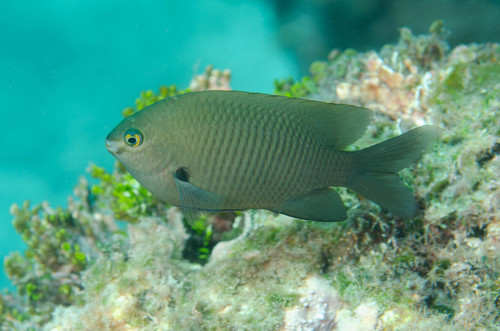
Pacific Gregory
Plectroglyphidodon fasciolatus
Meet the feisty gardener of the reef. The Pacific Gregory is a small damselfish with a massive personality, known for cultivating its own algae gardens and defending them against all comers.
Quick Identification
Size
Typically 10-15 cm (4-6 inches), reaching a maximum length of 17 cm (6.7 inches).
Colors
Dusky brownish-gray to near-black overall; body often displays 5-7 faint, dark vertical bars; juveniles may show blue specks.
Key Features
- Deep, oval-shaped body profile
- Faint dark vertical bands on the flanks
- Small, terminal mouth for grazing
- Extremely aggressive territorial behavior
When You’ll See Them
Behavior
The Pacific Gregory is a remarkably feisty member of the damselfish family, famous for its 'farming' behavior. Unlike many fish that wander the reef in search of food, the Gregory claims a specific patch of rock or coral as its own. It actively 'weeds' its territory by removing unpalatable algae and debris, encouraging the growth of high-quality filamentous algae which serves as its primary food source.
This species is intensely territorial and will defend its garden against fish many times its size. They are known to charge at parrotfish, surgeonfish, and even human divers who venture too close. While they live in high densities on many Indo-Pacific reefs, they are solitary in their management, with each individual maintaining a strict 'no-trespassing' zone around its specific crevice and grazing patch.
EverydayEarth exclusive
Camera Tips
To capture the Pacific Gregory on a backyard coastal or reef camera, you first need to identify their 'farm.' Look for a patch of reef that appears slightly greener or more lush than the surrounding area, usually guarded by a dark, oval-shaped fish darting in and out of a nearby hole. Place your underwater housing or AI-powered marine camera on a weighted tripod approximately 2 to 3 feet away from this territory. Avoid placing the camera directly on the algae patch, as this will trigger a constant defensive response that might obscure the lens.
Lighting is the biggest challenge when filming the Gregory, as their dark coloration can easily turn into a featureless silhouette against the bright reef background. Aim to film during the middle of the day when the sun is directly overhead to get maximum light penetration. If you are using an AI-camera, ensure it is set to a high contrast mode. Using a red filter can help restore natural colors if your camera is deeper than 10 feet, though these fish are most commonly found in very shallow water where natural light is abundant.
Because Pacific Gregorys are naturally curious and highly defensive, you don't actually need bait to attract them. The presence of the camera itself is often seen as a challenge or an intruder, and the fish will frequently swim directly up to the lens to inspect it or display its fins. For the best AI detection results, try to position the camera at a side-on angle to the fish’s favorite grazing spot to capture its full profile and those subtle vertical bands. Ensure your camera is securely anchored; the surge zones these fish prefer can easily tip over lightweight equipment.
Similar Species
Species that look similar or are commonly confused with Pacific Gregory.
Frequently Asked Questions
Record Pacific Gregory at your habitat
Connect a camera to start building your own species record — AI identifies every visitor automatically.