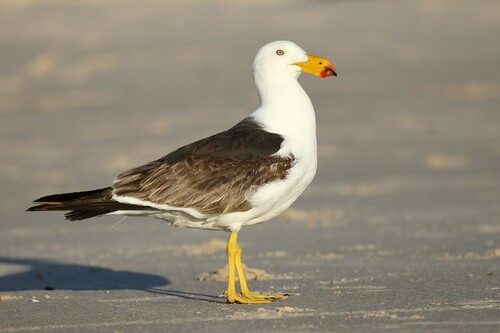
Pacific Gull
Larus pacificus
The undisputed heavyweight of the Australian coastline, the Pacific Gull is a magnificent predator known for its massive bill and striking black-and-white plumage. Discover how to spot this coastal sentinel and capture its powerful presence on camera.
Quick Identification
Size
Length: 58-66 cm (23-26 in); Wingspan: 137-157 cm (54-62 in); Weight: 900-1180 g (2-2.6 lbs)
Colors
Adults feature a snow-white body with striking black wings and back; massive yellow bill with red tips on both mandibles; yellow legs; juveniles are mottled brown.
Key Features
- Massive yellow bill with red 'blood-stained' tips on both mandibles
- Distinct black band near the tip of a white tail
- Thick-set, powerful build much larger than common Silver Gulls
- Pale creamy-white eye with a red orbital ring
When You’ll See Them
Behavior
The Pacific Gull is a true powerhouse of the Australian coastline, often seen patrolling beaches and rocky headlands with a commanding presence. Unlike the more social and frantic Silver Gulls, Pacific Gulls are often found in pairs or small family groups, maintaining a more dignified and predatory air. They are remarkably intelligent foragers, famously known for carrying heavy mollusks high into the air and dropping them onto rocks to shatter the shells and access the meat inside.
While they are coastal specialists, they are not above visiting harbors or docks to scavenge for scraps. However, they remain more wary of humans than their smaller cousins. Their deep, resonant 'ark-ark' call is a signature sound of the southern Australian wilderness, often used to defend their territory or signal to a mate. In areas where they overlap with the introduced Kelp Gull, they are often seen as the more dominant, though less numerous, species.
EverydayEarth exclusive
Camera Tips
To capture the Pacific Gull on your backyard or trail camera, location is everything. If you live near the coast, place your camera on a flat, elevated rocky outcrop or a sturdy fence post overlooking the shoreline. These birds love high vantage points to survey the area for food. Set your camera at a slight downward angle (about 10-15 degrees) to capture the detail on their upper wings and that iconic heavy bill. Because they are large birds, ensure the camera is at least 3 to 5 feet back to avoid 'clipping' their impressive wingspan if they choose to stretch or take off.
While we don't recommend feeding wildlife, if you are using your camera for scientific observation, a small amount of fish scrap or a 'lure' like a shiny piece of metal (which mimics a fish) can pique their curiosity. Be mindful of tides; these birds are most active around the water's edge during a receding tide when new rock pools and food sources are exposed. Position your camera to face away from the direct morning or evening sun to prevent lens flare from the water's reflection.
For the best shots, use a fast trigger speed (0.5 seconds or less) and a high shutter speed if your camera allows it, as their movements can be deceptively quick. Since they are diurnal, ensure your 'day mode' is optimized for high-contrast environments—the white feathers of a Pacific Gull can easily 'blow out' and lose detail in bright midday sun. Early morning or late afternoon light provides the best 'golden hour' glow that highlights the red tip of their bill and their pale eyes.
Similar Species
Species that look similar or are commonly confused with Pacific Gull.
Frequently Asked Questions
Record Pacific Gull at your habitat
Connect a camera to start building your own species record — AI identifies every visitor automatically.