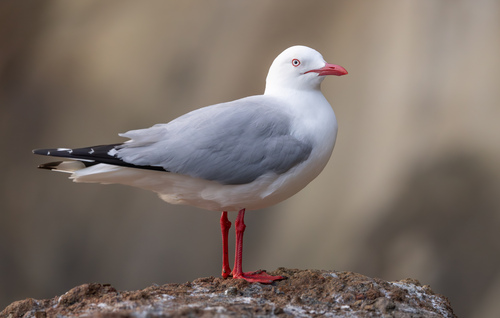
Silver Gull
Chroicocephalus novaehollandiae
Australia's most iconic coastal bird, the Silver Gull, is a master of survival and a frequent visitor to backyard birdbaths across the continent. With their striking red bills and bold attitudes, they are as fascinating to watch as they are common.
Quick Identification
Size
Length: 38–45 cm (15–18 in); Wingspan: 91–96 cm (36–38 in); Weight: 260–350 g (9–12 oz)
Colors
Pure white head, tail, and underparts; soft pearl-grey wings; black wingtips with white spots; adults have vibrant red bills, legs, and eye-rings.
Key Features
- Bright red bill and legs in adults
- White head and body with pale grey wings
- Distinctive white iris with a red orbital ring
- Black wingtips with white 'mirrors' or windows
When You’ll See Them
Behavior
The Silver Gull is perhaps Australia’s most familiar avian face, known for its incredible adaptability and bold personality. While naturally coastal, they have successfully moved into almost every environment where humans reside. They are highly social birds, often seen in large, noisy flocks where they communicate through a series of harsh 'karr-karr' calls. Their social structure is complex, involving frequent displays of dominance and ritualized begging, especially during the breeding season.
These gulls are expert opportunists and scavengers. In the wild, they are skilled at catching small fish and surface-skimming for plankton, but in suburban areas, they have mastered the art of 'kleptoparasitism'—stealing food from other birds or unsuspecting humans. Despite their reputation as 'chip thieves,' they play a vital role in cleaning up ecosystems by consuming carrion and insects that other species might overlook.
EverydayEarth exclusive
Camera Tips
To capture the best footage of Silver Gulls on a backyard or trail camera, placement is everything. Since these birds spend a significant amount of time foraging on the ground, mount your camera low—about 12 to 24 inches off the ground. Aiming the lens slightly upward or level with their eye line creates a much more intimate, professional-looking 'wildlife documentary' perspective compared to looking down on them from a fence post.
Lighting is your biggest challenge when photographing Silver Gulls. Their brilliant white plumage is easily 'blown out' (overexposed) in harsh midday sun, resulting in a loss of detail. Position your camera so it faces away from the direct sun, and try to capture them during the 'golden hours' of early morning or late afternoon. If your camera allows for exposure compensation, dialing it down slightly (-0.5 or -1.0) can help preserve the texture in their white feathers.
If you want to trigger frequent activity, a large, shallow birdbath is the ultimate lure. Silver Gulls are meticulous about preening and love to bathe, often resulting in high-energy splashing and wing-flapping that makes for fantastic video content. Set your camera’s trigger speed to the fastest possible setting and use a short 'Video' mode (10-15 seconds) with a minimal re-trigger delay to catch the fast-paced social interactions and squabbles that occur when multiple gulls visit at once.
In suburban settings, gulls are attracted to movement and bright objects. If you are struggling to get them in front of the lens, ensure the camera is in an open, flat area. While we don't recommend feeding them processed human food, a handful of dried mealworms or high-quality wet cat food placed in a dish can act as a safe and effective attractant to keep them in the frame long enough for a clear ID shot.
Similar Species
Species that look similar or are commonly confused with Silver Gull.
Frequently Asked Questions
Record Silver Gull at your habitat
Connect a camera to start building your own species record — AI identifies every visitor automatically.