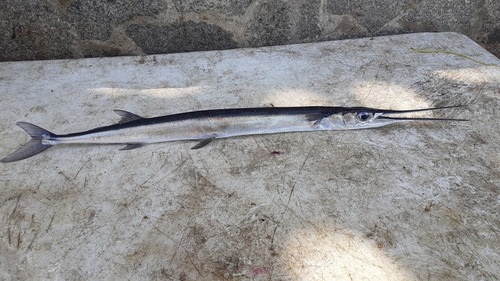
Pacific Needlefish
Tylosurus pacificus
A silver arrow of the Eastern Pacific, the Pacific Needlefish is a master of the surface strike. With its needle-thin beak and incredible leaping ability, it is one of the most specialized predators in coastal waters.
Quick Identification
Size
Typically 60-100 cm (24-39 inches) in length; weighs between 1-2.5 kg (2.2-5.5 lbs).
Colors
Dorsal side is a deep iridescent blue or blue-green, fading to brilliant silver or white on the flanks and belly; fins are generally translucent or slightly dusky.
Key Features
- Extremely elongated, slender body
- Beak-like jaws filled with many sharp, needle-like teeth
- Dorsal and anal fins positioned far back near the tail
- Absence of gill rakers
When You’ll See Them
Geographic range
Where Does the Pacific Needlefish Live?
The Pacific Needlefish is a staple of the Eastern Pacific Ocean, thriving in the warm tropical and subtropical waters along the coastline. Its territory extends from the southern reaches of Baja California and the Gulf of California southward through Central America to the coasts of Peru. It is also a common sight around major oceanic island chains including the Galapagos, Cocos, and Revillagigedo Islands.
Basemap © OpenStreetMap contributors
Behavior
The Pacific Needlefish is a high-speed surface predator designed for life in the upper water column. They are often seen cruising just inches below the surface, where their counter-shaded coloration—dark on top and silver on the bottom—makes them nearly invisible to predators from above and prey from below. They are solitary hunters but may congregate in small, loose groups where baitfish are abundant.
This species is well-known for its 'skittering' behavior, a defensive and hunting maneuver where it leaps out of the water and 'walks' across the surface on its tail. While usually wary of humans, they are famously attracted to artificial lights at night. This can lead to dangerous situations where the fish leap toward the light source at high speeds, occasionally striking boaters or fishers.
EverydayEarth exclusive
Camera Tips
Capturing the Pacific Needlefish requires an underwater camera setup specifically rigged for surface monitoring. Because these fish live almost exclusively in the top few feet of water, mount your camera in a waterproof housing roughly 30-60 cm below the surface. Aim the lens horizontally along the shoreline or slightly upward to capture the silver flash of their bodies against the sun. Pier pilings and boat docks are excellent mounting points, as needlefish often patrol these structures looking for baitfish.
Lighting is the most critical factor for a clear shot. During the day, position your camera so the sun is behind it; this prevents the bright surface glare from washing out the image and highlights the blue-green iridescence of the fish's back. In the early morning or late afternoon, the horizontal light creates a beautiful 'shimmer' effect on their scales. Use a high shutter speed (1/500 or faster) if your camera allows, as these fish move with sudden, jerky bursts of speed that can easily cause motion blur.
To attract Pacific Needlefish to your camera's field of view at night, utilize a submersible green or white LED light. These lights attract zooplankton, which in turn attract the small fish that needlefish prey upon. However, be extremely careful with equipment placement; needlefish are prone to jumping toward lights and can damage cameras or knock them off their mounts. Ensure all cables are tucked away and the housing is securely tethered to a solid structure.
Similar Species
Species that look similar or are commonly confused with Pacific Needlefish.
Frequently Asked Questions
Record Pacific Needlefish at your habitat
Connect a camera to start building your own species record — AI identifies every visitor automatically.