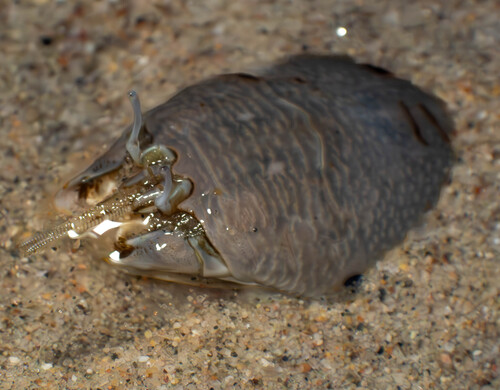
Pacific Sand Crab
Emerita analoga
The invisible engineer of the shoreline, the Pacific Sand Crab lives its life in the blur of crashing waves and shifting sands.
Quick Identification
Size
Females reach 3.5 cm (1.4 in) in length; males are smaller, typically around 2 cm (0.8 in)
Colors
Camouflaged grey, tan, or sandy-brown carapace with a pearlescent or translucent sheen; undersides are creamy white
Key Features
- Smooth, egg-shaped carapace
- Long feathery antennae used for filter feeding
- Tucked-under tail (telson) designed for rapid backward burrowing
When You’ll See Them
Geographic range
Where Does the Pacific Sand Crab Live?
Native to the temperate western coasts of the Americas, the Pacific Sand Crab occupies a unique disjunct distribution. In the Northern Hemisphere, they thrive from the Gulf of Alaska down to Baja California, Mexico. Interestingly, they are largely absent from the tropical waters of Central America but reappear in the Southern Hemisphere, ranging from the coast of Peru to the southern reaches of Chile.
Basemap © OpenStreetMap contributors
Behavior
The Pacific Sand Crab is a master of the "swash zone," the area of the beach where waves break and recede. Unlike many crabs that scuttle sideways, these crustaceans move exclusively backward, using their powerful legs to disappear into the liquefied sand in a matter of seconds. They are highly social but competitive, often found in dense colonies that move up and down the shoreline with the rising and falling tides to stay in the moist, food-rich sand.
Their feeding strategy is a marvel of adaptation. As a wave recedes, the crab extends its long, feathery antennae into the flowing water to trap plankton and organic detritus. They then pull the antennae through their mouthparts to consume the gathered nutrients. Because they are a primary food source for shorebirds and surf-dwelling fish, their lives are a constant race between feeding and evading predators by staying buried.
EverydayEarth exclusive
Camera Tips
Capturing the Pacific Sand Crab requires a waterproof action camera with high-speed video capabilities. Because these crabs move incredibly fast when burrowing, a standard 30fps frame rate will often result in a blur. Set your camera to at least 60fps or 120fps (slow motion) to capture the intricate mechanics of their legs and antennae. Place the camera on a small, weighted tripod or a flat sand-stake just inches above the sand during a receding tide. Ensure the housing is rated for saltwater and rinse it thoroughly with fresh water immediately after use.
Focus your lens on the area just behind the highest point of the receding wave. Look for the "V" shaped ripples in the sand—this is the signature of a buried crab's antennae breaking the surface. Aim the camera at these ripples. Since you cannot easily bait a filter feeder, your best bet is to find a high-density colony. You can encourage activity by gently disturbing the sand with your foot to see where they re-emerge and settle back down.
The best lighting occurs during the "Golden Hour" at low tide when the wet sand acts like a mirror. A low-angle shot looking toward the sunset can create dramatic silhouettes of the crabs as they emerge from the suds. Use a wide-angle lens to capture the scale of the colony against the crashing surf. If your camera has a macro mode, try to get within 6-10 inches of a stationary crab to see the feathery detail of the antennae as they whip through the water.
Similar Species
Species that look similar or are commonly confused with Pacific Sand Crab.
Frequently Asked Questions
Record Pacific Sand Crab at your habitat
Connect a camera to start building your own species record — AI identifies every visitor automatically.