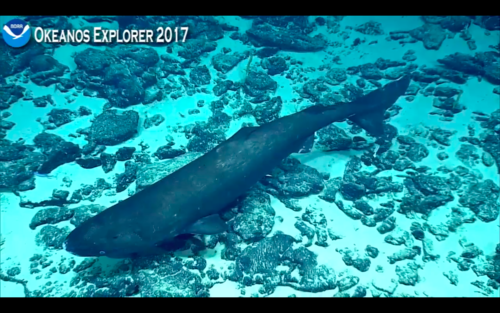
Pacific Sleeper Shark
Somniosus pacificus
Meet the ghost of the abyss, a massive deep-sea predator that thrives in the freezing darkness of the North Pacific. The Pacific Sleeper Shark is a mysterious giant, combining a sluggish demeanor with the heart of a versatile hunter.
Quick Identification
Size
Reaches lengths of 3.7–4.4 m (12–14 ft) and weights up to 880 kg (1,940 lbs), though some individuals may grow larger.
Colors
Uniform dark gray, slate-brown, or blackish-violet with no distinctive spotting or saddle marks.
Key Features
- Large, heavy cylindrical body
- Small, low dorsal fins without spines
- Short, blunt snout with a small mouth
- Eyes often harbor pinkish parasitic copepods
- Gill slits are small and located low on the head
When You’ll See Them
Geographic range
Where Does the Pacific Sleeper Shark Live?
The Pacific Sleeper Shark is a titan of the deep, primarily native to the cold temperate and subarctic waters of the North Pacific Ocean. Its core range extends from the icy coasts of Alaska and the Bering Sea southward to Japan and the waters off Baja California, Mexico. While it thrives in the northern latitudes, this species has also been documented in the tropical Pacific and as far south as the Antarctic Ocean, suggesting it utilizes deep, cold-water corridors to traverse the globe away from the warm surface layers.
Basemap © OpenStreetMap contributors
Behavior
Despite its sluggish appearance and name, the Pacific Sleeper Shark is a highly versatile and effective predator. It is known for its slow, energy-conserving swimming style, which allows it to glide through the dark, cold depths of the abyss undetected. This shark is a master of vertical migration, spending its days in the crushing pressures of the deep sea and occasionally rising toward the surface at night to follow prey. It possesses high concentrations of urea and trimethylamine oxide in its tissues, which act as biological antifreeze and pressure stabilizers.
While often characterized as a scavenger feeding on whale carcasses, recent studies reveal it is an active hunter capable of capturing fast-moving prey like giant squid and even harbor seals. Socially, they are solitary wanderers, rarely encountered by humans due to their extreme habitat preferences. They are remarkably non-aggressive toward divers in the rare instances they meet in shallow northern waters, though their sheer size and powerful jaws demand extreme caution.
EverydayEarth exclusive
Camera Tips
Capturing a Pacific Sleeper Shark on camera is a significant challenge that requires specialized deep-sea equipment rather than a standard backyard camera. For coastal residents in Alaska or the Pacific Northwest, the most effective method is using a Baited Remote Underwater Video System (BRUVS). This involves a high-pressure waterproof housing and a sturdy frame that can be lowered to the seafloor or suspended at depth. Because these sharks inhabit high-pressure environments, ensure your housing is rated for at least 300 meters if deploying near the continental shelf break.
Bait is essential for attracting this species. Use highly oily fish with a strong scent profile, such as mackerel, salmon heads, or squid. Secure the bait in a perforated container or 'bait bag' attached about one meter in front of the lens. This encourages the shark to linger and bump the bait, providing clear identification of the snout and tooth structure. Since the deep ocean is pitch black, you will need powerful external LED lights. Using red filters or lower-intensity red light can sometimes prevent the 'startle response' in deep-sea creatures, though Sleeper Sharks are generally unfazed by artificial light.
Timing and location are everything. Deploy your camera near steep underwater drop-offs or submarine canyons where upwelling occurs. In high-latitude regions like the Gulf of Alaska, you may have luck in shallower waters (50-100m) during the winter months when surface temperatures drop. Set your camera to record in high-definition with a wide-angle lens, as these sharks can reach 14 feet in length and may pass very close to the rig. Use a high-capacity SD card and set your camera to record on a timer—for example, 2 minutes of footage every 10 minutes—to maximize the battery life during long deployments.
Similar Species
Species that look similar or are commonly confused with Pacific Sleeper Shark.
Frequently Asked Questions
Record Pacific Sleeper Shark at your habitat
Connect a camera to start building your own species record — AI identifies every visitor automatically.