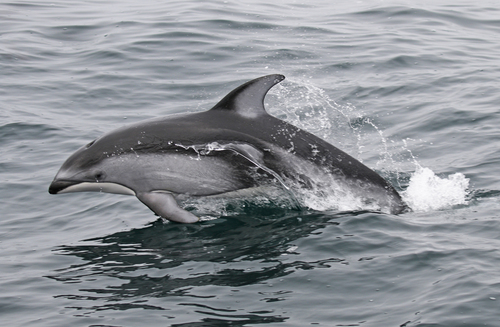
Pacific White-sided Dolphin
Aethalodelphis obliquidens
The ultimate acrobat of the Pacific, this dolphin is known for its striking tri-color markings and its incredible displays of speed and agility. Whether they are bow-riding or leaping in the surf, they are a magnificent sight for any coastal observer.
Quick Identification
Size
5.5 to 8 feet (1.7 to 2.5 meters) in length; 330 to 440 lbs (150 to 200 kg) in weight
Colors
Tri-colored pattern featuring a dark gray or black back, light gray sides, and a white belly; dorsal fin is bi-colored with a dark leading edge and light gray trailing edge
Key Features
- Strongly curved, bi-colored dorsal fin
- Light gray 'suspenders' stripes running along the back
- Blunt, short snout without a distinct beak
- Highly acrobatic behavior including frequent leaping and spinning
When You’ll See Them
Behavior
The Pacific White-sided Dolphin is widely regarded as one of the most playful and energetic cetaceans in the North Pacific. They are highly social animals, typically traveling in pods of 10 to 100 individuals, though they occasionally form 'super-pods' numbering in the thousands. Their surface behavior is spectacular, often involving high leaps, somersaults, and 'porpoising' at high speeds across the water.
These dolphins are exceptionally curious and are famous among mariners for their love of bow-riding. They will often divert their course to swim in the pressure wave created by a boat's hull. In the wild, they are frequently seen interacting with other species, such as California Sea Lions and Humpback Whales. While they are friendly toward vessels, they are efficient pack hunters that use sophisticated echolocation to navigate and locate prey in deep or murky waters.
EverydayEarth exclusive
Camera Tips
Capturing the Pacific White-sided Dolphin on an AI-powered camera requires a setup optimized for high-speed action. Since these dolphins can travel at speeds exceeding 25 mph, you should prioritize a fast shutter speed or 'action mode' to prevent motion blur during breaches. If you are mounting a camera on a coastal pier or a boat, use a high-quality polarizing filter. This is essential for cutting through water surface glare, allowing your camera to capture the dolphin’s distinctive light gray 'suspenders' and white belly even when they are just beneath the surface.
For coastal 'backyard' observers with ocean-facing properties, mount your camera at an elevated angle. A higher vantage point reduces the distortion caused by waves and provides a better perspective of the pod's formation. Look for natural indicators of dolphin activity to trigger your recording, such as 'bait balls' or flocks of diving birds; these dolphins are often the primary force driving fish to the surface. Set your AI detection to look for high-contrast movement, as the splash of a breach is often the best trigger for a recording session.
Because salt spray is highly corrosive, ensure your camera is housed in an IP67-rated waterproof casing and wipe the lens regularly with a microfiber cloth. Early morning and late afternoon provide the best lighting, as the low sun angle highlights the texture of the dolphin's skin and the spray of their blowholes. If your camera supports it, use a telephoto lens (100mm or higher) to get close-up shots of the dorsal fins, which are as unique as human fingerprints and can be used for individual identification.
Similar Species
Species that look similar or are commonly confused with Pacific White-sided Dolphin.
Northern Right Whale Dolphin
This species is much more slender and lacks a dorsal fin entirely, unlike the prominent fin of the White-sided Dolphin.
Dall's Porpoise
Dall's Porpoises have a stockier, 'rooster-tail' splash and a much smaller, triangular dorsal fin compared to the dolphin's curved fin.
Frequently Asked Questions
Record Pacific White-sided Dolphin at your habitat
Connect a camera to start building your own species record — AI identifies every visitor automatically.