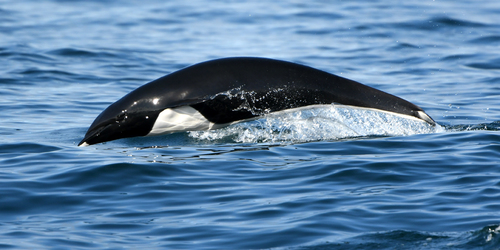
Northern Right Whale Dolphin
Lissodelphis borealis
The only finless dolphin in the North Pacific, this sleek 'sea-serpent' of the deep is a master of high-speed acrobatics. Its striking black-and-white tuxedo and slender frame make it one of the most unique sightings for any coastal observer.
Quick Identification
Size
Length: 2 to 3.1 meters (6.6 to 10.2 feet); Weight: 60 to 115 kg (130 to 250 lbs)
Colors
Jet-black upper body and sides with a striking white patch on the chest and underbelly; occasionally a white tip on the lower jaw.
Key Features
- Complete absence of a dorsal fin
- Extremely slender and streamlined profile
- Small, recurved pectoral fins
- White ventral (underside) marking shaped like an hourglass
When You’ll See Them
Behavior
Northern Right Whale Dolphins are high-energy socialites of the deep ocean. They travel in pods that typically range from 5 to 200 individuals, though massive 'super-pods' of over 2,000 have been recorded. They are remarkably fast and graceful swimmers, often engaging in a behavior called 'low-leaping' where they skip across the water surface like a stone. This creates a distinct splashing pattern that can be seen from a distance, looking more like a school of fish than typical dolphin breaching.
These dolphins are frequently seen associating with other marine life, particularly Pacific White-sided Dolphins and various species of whales. While they are known to bow-ride on occasion, they are generally more elusive and 'boat-shy' than the common dolphin. When startled, the entire pod may flee in a synchronized, high-speed rush, creating a spectacular 'rooster-tail' of spray behind them.
EverydayEarth exclusive
Camera Tips
Capturing the Northern Right Whale Dolphin on camera requires a specialized approach because they lack a dorsal fin—the primary feature most AI wildlife models use to identify dolphins. If you are setting up a camera on a coastal pier, high-altitude cliff, or a marine buoy, you must configure your AI to trigger on movement and 'low-profile' shapes. Traditional 'fin-spotting' algorithms will miss them entirely. Instead, look for a 'log-like' silhouette that breaks the water surface without the vertical disruption of a fin.
For the best results, use a circular polarizing filter on your lens to cut through the ocean's surface glare. These dolphins are jet-black, meaning they can easily disappear into the dark water on cloudy days. Aim for 'Golden Hour' lighting—shortly after sunrise or before sunset—when the low sun catches the white chest patch as they leap. This contrast is the best way to get a clear, high-quality identification shot. Set your camera’s shutter speed to at least 1/2000s to freeze their rapid 'skipping' motion across the waves.
If you are using a stationary trail camera mounted on a boat or a coastal vantage point, use a long focal length (at least 300mm equivalent) and focus on 'lead-shooting.' Because these dolphins swim in tight, fast-moving lines, if you see one leap, the rest of the pod is likely following in the same trajectory. Adjust your trigger speed to the fastest possible setting; a delay of even half a second will result in a frame full of empty water.
Seasonality plays a huge role in camera placement. In the winter, these dolphins move further south toward Southern California and Baja, while in the summer, they migrate as far north as the Gulf of Alaska. Check local sea surface temperature charts; they prefer water between 8°C and 19°C (46°F-66°F). Positioning your equipment near deep-water canyons that come close to shore will significantly increase your chances of a successful capture.
Similar Species
Species that look similar or are commonly confused with Northern Right Whale Dolphin.
Frequently Asked Questions
Record Northern Right Whale Dolphin at your habitat
Connect a camera to start building your own species record — AI identifies every visitor automatically.