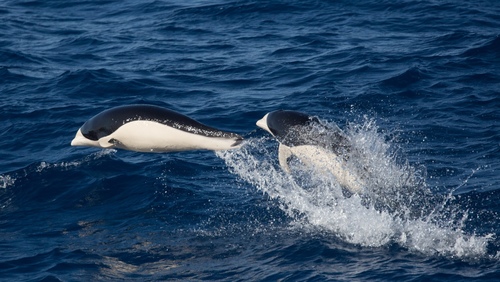
Southern Right Whale Dolphin
Lissodelphis peronii
Meet the ocean's most streamlined acrobat. The Southern Right Whale Dolphin is a finless wonder of the deep, known for its striking tuxedo colors and incredible high-speed leaps.
Quick Identification
Size
Adults typically range from 2 to 3 meters (6.5 to 10 feet) in length and weigh between 60 and 116 kg (132 to 256 lbs).
Colors
Strikingly bicolor with a sharp demarcation line; the upper half of the body is glossy black while the lower half, including the beak and flippers, is brilliant white.
Key Features
- Total absence of a dorsal fin, resulting in a smooth, flat back
- Distinctive 'tuxedo' color pattern with a sharp transition from black to white
- Extremely slender and streamlined body with a short, pointed beak
- Small, elegantly curved white flippers and narrow tail flukes
When You’ll See Them
Behavior
Southern Right Whale Dolphins are among the most active and social cetaceans in the Southern Hemisphere. They are frequently observed in large pods ranging from 10 to over 1,000 individuals. These dolphins are incredibly fast swimmers, often reaching speeds that allow them to 'porpoise' out of the water in long, low leaps. Because they lack a dorsal fin, their movement through the water is remarkably smooth, and they create very little surface disturbance compared to other dolphin species when swimming calmly.
While they are generally considered shy around large, noisy vessels, they are known to occasionally bow-ride on faster boats or associate with other species like Pilot whales and Hourglass dolphins. Their social structure is highly synchronized; when a pod is startled, the entire group will often leap in unison, creating a spectacular display of black-and-white flashes across the ocean surface. They are deep-water specialists, rarely venturing near the coastline unless the continental shelf is very narrow.
EverydayEarth exclusive
Camera Tips
Capturing the Southern Right Whale Dolphin requires a unique setup because they are pelagic animals, meaning they live in the open ocean rather than near the shore. To use an AI-powered camera for this species, it must be mounted on a stable marine platform, such as a research vessel or a long-range expedition boat. Because they lack a dorsal fin, standard AI models trained on 'fin detection' will likely fail. You should configure your EverydayEarth AI to trigger on 'high-contrast movement' or 'bicolor shapes' to ensure it recognizes the tuxedo-like pattern as it breaks the surface.
For the best shot, mount your camera at a height of 5 to 10 feet above the waterline. Use a polarizing filter to minimize the intense ocean glare, which is the primary obstacle for clear AI identification at sea. A downward angle of about 15 to 20 degrees is ideal for capturing the dolphin's back and the sharp line where the black skin meets the white belly. Set your camera to a fast shutter speed (at least 1/2000s) because these dolphins move with incredible velocity; any slower and you will only capture a black-and-white blur.
Since these dolphins are most active in the cool currents of the Southern Ocean, ensure your camera housing is rated for saltwater spray and cold temperatures. If you are using a trigger-based system, set the 'burst mode' to capture at least 5-10 frames per second. This is crucial because their 'porpoising' leaps are very low to the water and happen in a fraction of a second. Without a dorsal fin to track, the AI needs to be sensitive to the white splash or the 'rooster tail' of water they kick up when moving at high speeds.
The best time for high-quality imagery is during 'the golden hour'—just after sunrise or before sunset—when the side-lighting emphasizes the smooth texture of their finless backs. However, for AI data collection, mid-day light provides the best contrast between the black and white pigmentation. If you are deploying a stationary buoy camera, focus your efforts near areas of upwelling where squid are plentiful, as these are the dolphins' primary 'kitchens' where they are most likely to linger rather than just swim past.
Similar Species
Species that look similar or are commonly confused with Southern Right Whale Dolphin.
Frequently Asked Questions
Record Southern Right Whale Dolphin at your habitat
Connect a camera to start building your own species record — AI identifies every visitor automatically.