Pacific yew
Taxus brevifolia
A hidden gem of the ancient forest, the Pacific yew is a resilient, slow-growing conifer famous for its vibrant red arils and historically significant, life-saving bark.
Quick Identification
Size
Typically 5–15 meters (15–50 feet) tall; trunk diameter 30–50 cm (12–20 inches). Small specimens may appear as shrubs.
Colors
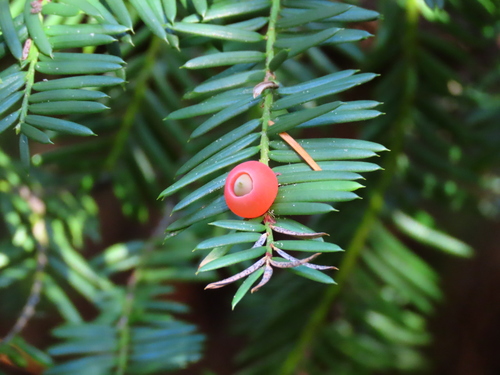
Deep green needles with pale undersides; reddish-purple to brown bark; bright translucent red seed covers (arils).
Key Features
- Flat, dark green needles with pointed (but not sharp) tips
- Paper-thin bark that peels in irregular scales to reveal reddish tones
- Bright red, cup-shaped fleshy arils surrounding a single seed
- Twisting, often asymmetrical trunk and dense branching
When You’ll See Them
Behavior
The Pacific yew is a patient, slow-growing resident of the Pacific Northwest's understory. Unlike many sun-seeking conifers, it thrives in deep shade and high humidity, often found lurking beneath the canopy of giant Douglas firs and Western red cedars. It grows at a glacial pace, sometimes taking centuries to reach its modest full height. Because its wood is incredibly dense and flexible, it was historically prized for making hunting bows and tools.
In the ecosystem, the Pacific yew acts as a vital shelter and food source. While its needles and seeds are toxic to humans and many domestic animals, they provide important forage for local wildlife. The tree doesn't compete for dominance in the forest; instead, it creates a lush, evergreen thicket that serves as a nursery for various forest floor species and a reliable hideout for mammals during heavy snow or rain.
EverydayEarth exclusive
Camera Tips
To capture the best images of a Pacific yew and the life it supports, think of the tree as a stage rather than a subject. The most dynamic shots occur during the late summer and early autumn when the bright red arils ripen. Position your camera on a nearby branch or a sturdy tripod about 5 to 7 feet high, focusing specifically on a cluster of fruit. This is the prime spot to record Varied Thrushes, Cedar Waxwings, and Nuthatches as they visit to feed on the fleshy seed covers. Use a high shutter speed or 'Burst Mode' to freeze the action of these fast-moving birds.
For larger visitors, take advantage of the yew's low-hanging, dense canopy, which offers excellent thermal cover. Place your camera 2 to 3 feet off the ground at the edge of the tree’s drip line, facing toward the trunk. This setup frequently captures Black-tailed deer or Roosevelt elk seeking shade during the day or shelter during a storm. Because these trees live in dark, damp environments, ensure your camera has a sensitive 'No-Glow' infrared flash. This prevents the bark from being washed out by white light while still capturing crisp, high-contrast images of nocturnal visitors like Northern flying squirrels or martens that might use the branches as a highway.
If you want to highlight the tree's unique, scaly bark, set up your camera for 'Macro' or close-focus shots during the 'Golden Hour'—just before sunset. The low-angle light can penetrate the forest canopy and make the reddish-purple hues of the bark pop against the deep green needles. Avoid placing the camera facing directly south, as the dappled sunlight common in yew habitats can create harsh 'hot spots' on the sensor that trigger false motions or obscure the fine texture of the foliage.
Similar Species
Species that look similar or are commonly confused with Pacific yew.
Frequently Asked Questions
Record Pacific yew at your habitat
Connect a camera to start building your own species record — AI identifies every visitor automatically.