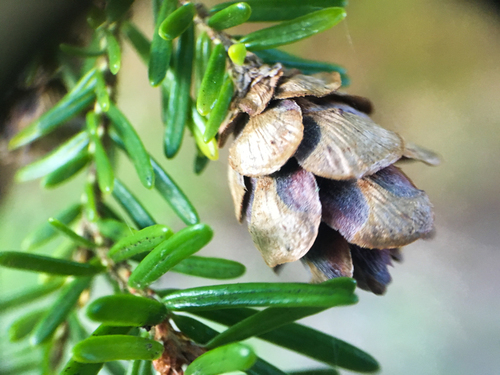
western hemlock
Tsuga heterophylla
Defined by its graceful, drooping top and delicate needles, the Western Hemlock is the crown jewel of the Pacific Northwest's misty rainforests.
Quick Identification
Size
Typically 30–70 m (100–230 ft) tall with a trunk diameter of 1–2.7 m (3–9 ft)
Colors
Glossy dark green needles with two white stripes on the underside; grayish-brown bark becoming reddish-brown and furrowed with age
Key Features
- Distinctive drooping or 'lazy' leading shoot at the tree's peak
- Short, flat needles of varying lengths arranged in two rows
- Small, egg-shaped cones approximately 2–3 cm (1 inch) long
- Deeply furrowed bark with a dark red inner layer
When You’ll See Them
Behavior
The western hemlock is a cornerstone species of the Pacific Northwest, known for its incredible shade tolerance. Unlike many other conifers that require a clearing to grow, western hemlock seedlings can survive for decades in the deep shade of a forest floor, waiting for a gap in the canopy to open. This allows it to eventually dominate old-growth forests as a 'climax' species.
A fascinating aspect of its life cycle is its reliance on 'nurse logs.' In many moist forests, western hemlock seeds germinate most successfully on the decaying trunks of fallen trees rather than on the forest floor itself. As the seedling grows, its roots wrap around the log and reach the soil; when the nurse log eventually rots away, the mature hemlock is left standing on 'stilt' roots.
EverydayEarth exclusive
Camera Tips
When using an AI-powered camera to identify a western hemlock, the 'money shot' is the tree's silhouette. Unlike the rigid, upright tops of Douglas-firs or spruces, the western hemlock has a characteristic drooping leader (the very top of the tree) that looks like a bent wand. If your backyard allows for a wide-angle view, position your camera to capture the upper third of the canopy against a clear sky to confirm this 'lazy top' identification.
For a more detailed look at the needles and cones, mount your camera 5-7 feet high on a nearby structure or tree, facing a lower hemlock branch. Western hemlock needles are unique because they are 'heterophylla' (different leaves), meaning the needles on a single twig are visibly different lengths. Use a high-resolution setting or a macro-lens attachment if available to capture the two distinct white stomatal bands on the underside of the needles, which is a primary diagnostic feature for AI identification.
Because western hemlocks are magnets for wildlife, especially during the winter, placing a camera near a cluster of their small, pendant cones can yield great results. These cones are a preferred food source for crossbills, siskins, and squirrels. Set your camera to 'Burst Mode' or high-frame-rate video to capture the rapid movement of birds prying seeds from the delicate cone scales. Since these trees often grow in deep shade, ensure your camera has a strong low-light sensor or adjust your exposure compensation slightly higher to avoid underexposed images in the dark forest understory.
If you have a western hemlock growing on a nurse log, this is a perfect location for a long-term time-lapse. Position the camera at ground level, angled upward to show both the decaying log and the emerging stilt roots of the hemlock. This captures the unique 'circle of life' behavior of the species. In the autumn, the mossy base of these trees often hosts a variety of fungi, providing a colorful foreground for your wildlife shots.
Similar Species
Species that look similar or are commonly confused with western hemlock.
Frequently Asked Questions
Record western hemlock at your habitat
Connect a camera to start building your own species record — AI identifies every visitor automatically.