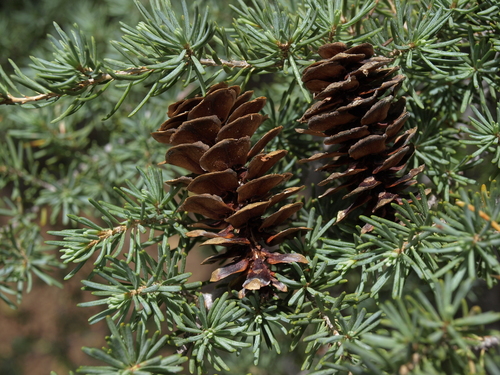
mountain hemlock
Tsuga mertensiana
The crown jewel of the subalpine, the Mountain Hemlock is a masterpiece of high-altitude resilience. Its graceful, drooping boughs and striking blue-green needles define the misty ridgelines of the Pacific coast.
Quick Identification
Size
Height ranges from 20-40 meters (66-131 feet), with exceptionally old specimens reaching 60 meters (197 feet). Trunk diameter typically spans 0.5-1.5 meters (1.6-4.9 feet).
Colors
Foliage is a distinctive glaucous blue-green or gray-green on all sides. Bark is a dark reddish-brown to charcoal gray, becoming deeply furrowed with age.
Key Features
- Needles radiate in all directions around the twig like a bottle-brush
- Cones are cylindrical and 1-3 inches long, starting deep purple and maturing to brown
- The leader (the very top of the tree) and branch tips characteristically droop or nod downwards
- Bark is thick and deeply divided into narrow, squarish ridges
When You’ll See Them
Behavior
Mountain Hemlock is the rugged, slow-growing sentinel of the high country. Unlike many trees that snap under the weight of heavy mountain snows, this species has evolved incredible flexibility. Its branches are designed to droop sharply downward, creating a 'tenting' effect that sheds heavy drifts while protecting the inner trunk. In the harshest alpine environments, it often takes on a 'krummholz' form—stunted, twisted, and shrub-like—as it battles extreme winds and ice.
As an ecosystem cornerstone, it provides vital services to mountain wildlife. It acts as a primary shelter for subalpine birds and mammals during winter storms. Because it is more sun-tolerant than its cousin, the Western Hemlock, it is often seen colonizing the edges of alpine meadows, where it slowly expands the forest boundary. It is a long-lived species, with some individuals surviving for over 800 years in the cool, moist climates of the Pacific Northwest and Alaska.
EverydayEarth exclusive
Camera Tips
Capturing the majesty of a Mountain Hemlock on a trail camera requires a shift in perspective; think of the tree as a 'habitat hub' rather than just a static object. These trees are famous for creating 'snow caves' at their base where the low-hanging branches meet the ground. Position your camera on a nearby rock or a different tree, aiming toward the sheltered area beneath the Mountain Hemlock's lower canopy. This is a prime spot for capturing elusive high-altitude mammals like the American Marten, Sooty Grouse, or even a Pacific Fisher looking for a dry place to rest.
Lighting is your biggest challenge and your greatest asset with this species. The needles have a beautiful waxy, blue-green sheen that can look stunning in the golden hour. To avoid the harsh 'blow out' of high-altitude sun, face your camera North or Northeast. This orientation prevents the sun from shining directly into the lens and highlights the deep, craggy texture of the reddish-brown bark and the unique 'starburst' needle pattern without excessive glare.
For those monitoring year-round, remember that these trees live in areas of massive snowfall. If you mount your camera at chest height in August, it will be buried under ten feet of snow by January. For winter monitoring, mount your camera at least 8 to 10 feet up the trunk of a neighboring tree, angled downward. This ensures you can capture the 'snow-globe' beauty of the hemlock and the tracks of animals like snowshoe hares that travel across the top of the snowpack.
If you are interested in time-lapse photography, the Mountain Hemlock is a perfect subject. Its nodding leader (the very top point of the tree) moves gracefully in the wind. Set a long-term time-lapse to watch the tree 'bend but not break' during winter storms, or capture the dramatic transition as the deep purple spring cones emerge and ripen into the reddish-brown cones of autumn. Avoid using high-intensity flashes at close range, as the glaucous needles are highly reflective and can cause a 'white-out' effect in night shots.
Similar Species
Species that look similar or are commonly confused with mountain hemlock.
Western Hemlock
Has smaller cones and flat, two-ranked needles, whereas Mountain Hemlock has larger cones and needles that radiate in all directions.
Subalpine Fir
Features upright, barrel-shaped cones that sit on top of branches and smooth bark with resin blisters, unlike the hanging cones and furrowed bark of the hemlock.
Frequently Asked Questions
Record mountain hemlock at your habitat
Connect a camera to start building your own species record — AI identifies every visitor automatically.