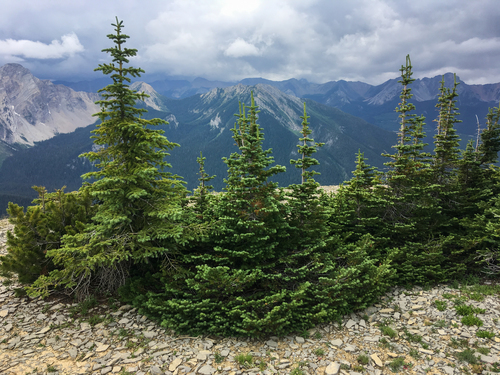
subalpine fir
Abies lasiocarpa
The spire of the high country, the subalpine fir is a resilient sentinel of the peaks. Known for its candle-like cones and needle-sharp silhouette, this tree is the ultimate provider of shelter in the harshest mountain winters.
Quick Identification
Size
Typically grows 20–35 meters (66–115 feet) tall with a trunk diameter of 45–60 centimeters (18–24 inches); stunted krummholz forms at timberline may be less than 1 meter (3 feet) tall.
Colors
Deep blue-green needles with silver-white stripes underneath; silvery-gray bark; dark purple to indigo-blue upright cones.
Key Features
- Distinctive narrow, steeple-like crown silhouette
- Flat, blunt needles with two white stomatal bands
- Dark purple cones that grow upright on top branches
- Smooth grayish bark featuring resin-filled blisters
When You’ll See Them
Behavior
The subalpine fir is a slow-growing and incredibly resilient conifer that defines the landscape of the high-country wilderness. Its most famous characteristic is its narrow, spire-like shape, an evolutionary adaptation that allows the tree to shed heavy mountain snowfall without its branches snapping. In the highest, most wind-swept elevations, it adopts a 'krummholz' growth form, where it grows horizontally across the ground like a gnarled shrub to survive the freezing blasts of winter.
This species plays a foundational role in its ecosystem, often acting as a 'pioneer' that colonizes harsh sites and creates a microclimate that allows other plants to take root. It is a vital source of thermal cover for large mammals like elk and mule deer, who huddle beneath its dense lower branches to escape storms. While it can live for over 250 years, it is sensitive to fire due to its thin, resinous bark and shallow root system.
EverydayEarth exclusive
Camera Tips
When using an AI camera to capture the subalpine fir, your primary goal is to showcase its unique architectural silhouette. For the best 'hero' shot of the tree, place your camera 30 to 50 feet away on a tripod, aiming for a slightly upward angle to emphasize the steeple-like crown against the sky. The 'Golden Hour'—just after sunrise or before sunset—is the ideal time to shoot, as the low-angled light catches the silvery texture of the bark and makes the deep purple cones practically glow. If your camera has HDR (High Dynamic Range) settings, enable them to manage the high contrast between the dark needles and bright mountain snow.
To capture the wildlife that frequents these trees, focus your lens on the middle-to-upper branches during late summer and autumn. This is when the cones are mature. Position your camera on a nearby tree or a tall post, aiming at a cluster of upright cones. You are likely to trigger the camera with sightings of Clark’s Nutcrackers, Pine Grosbeaks, and Red Squirrels, all of which treat the subalpine fir like a seasonal buffet. Setting your camera to 'Burst Mode' or 'High-Speed Video' is essential for these fast-moving visitors, as they often dart in and out of the dense foliage.
In winter, the subalpine fir becomes a dramatic subject for time-lapse photography. If you can secure your camera in a weather-proof housing, set it to take a photo every 30 minutes during a snowstorm. You will capture the incredible 'slumping' behavior of the branches as they bend to shed snow—a mechanical marvel of the plant world. Because batteries drain rapidly in the cold subalpine air, always use high-quality lithium batteries or an external solar power pack mounted on a south-facing branch to keep the camera running through the winter months.
Similar Species
Species that look similar or are commonly confused with subalpine fir.
Balsam Fir
Balsam fir is found in the East and Midwest; subalpine fir is a Western species with longer needles and a narrower crown.
White Fir
White fir needles are much longer (2-3 inches) and curve upward, whereas subalpine fir needles are shorter and flatter.
Douglas-fir
Douglas-fir has downward-hanging cones with 'mouse-tail' bracts, unlike the upright cones of the subalpine fir.
Frequently Asked Questions
Record subalpine fir at your habitat
Connect a camera to start building your own species record — AI identifies every visitor automatically.