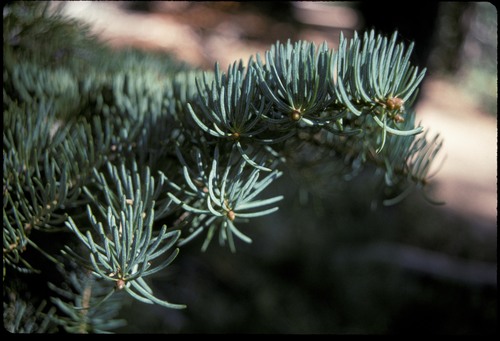
white fir
Abies concolor
A towering icon of the American West, the White Fir is beloved for its striking silver-blue needles and refreshing citrus scent. This resilient evergreen transforms any backyard into a high-mountain sanctuary for local wildlife.
Quick Identification
Size
Typically 25-60 meters (80-200 feet) tall with a trunk diameter of 0.9-1.5 meters (3-5 feet)
Colors
Silvery-blue to glaucous green needles; young bark is smooth and ash-gray, while mature bark is thick and deeply furrowed into corky ridges
Key Features
- Flat, flexible needles 1.5 to 3 inches long
- Needles curve upward in a distinctive 'J' or 'U' shape
- Upright cones that grow toward the sky rather than hanging down
- Smooth, light gray bark that becomes deeply textured with age
- Strong citrus-like scent when needles are crushed
When You’ll See Them
Behavior
The White Fir is a slow-growing, long-lived conifer that plays a vital role in the montane ecosystems of the American West. Unlike many other conifers that thin out as they age, the White Fir maintains a dense, spire-like crown that provides excellent thermal cover for wildlife during harsh winters. It is known as a 'climax species' in many forests, meaning it can grow in the shade of other trees and eventually take over the canopy as older trees die off.
Beyond its structural role, the White Fir is a hub of biological activity. Its needles and seeds are a critical food source for various birds and mammals, while its dense foliage offers nesting sites for species like the Northern Goshawk. In the garden or backyard setting, it acts as a windbreak and a year-round sanctuary for songbirds, providing a steady presence that changes slowly with the seasons rather than shedding its leaves.
EverydayEarth exclusive
Camera Tips
When capturing a White Fir on your backyard or trail camera, the goal is often less about the tree moving and more about the wildlife it attracts. Position your camera at a medium distance (10-15 feet) with a wide-angle lens to capture the full silhouette of the tree, especially during the winter when the silver-blue needles contrast beautifully against the snow. If you are looking to capture bird activity, mount a camera on a nearby structure or a sturdier branch facing a cluster of young growth or cones; the dense needles make for excellent 'natural' backdrops that highlight the colors of visiting nuthatches or chickadees.
For those interested in the mammals that visit White Firs, place your camera near the base of the trunk at a low angle (1-2 feet off the ground). Squirrels and chipmunks frequently visit the base to forage for fallen cone scales. If you have a larger property, White Firs are often 'rub trees' for deer or elk; look for signs of bark wear and set your camera at chest height to capture these social behaviors. Avoid placing the camera facing directly into the setting or rising sun, as the light reflecting off the glaucous (waxy) needles can cause significant overexposure or 'white-out' in your images.
Time-lapse mode is particularly rewarding with the White Fir. Set your camera to take one photo every hour during daylight to document the 'heavy' look of the tree during a snowstorm or the slow unfurling of new, bright green growth in the spring. Because the tree is stationary, you can use slower shutter speeds in low light to capture the soft, painterly texture of the needles without worrying about motion blur from the subject itself.
Similar Species
Species that look similar or are commonly confused with white fir.
Subalpine Fir
Subalpine fir has much shorter needles (1 inch) and a more narrow, spire-like shape compared to the broader White Fir.
Douglas Fir
Douglas Fir cones hang down and have 'mouse-tail' bracts, while White Fir cones stand perfectly upright.
Blue Spruce
Spruce needles are sharp and roll easily between your fingers, whereas White Fir needles are flat and soft to the touch.
Frequently Asked Questions
Record white fir at your habitat
Connect a camera to start building your own species record — AI identifies every visitor automatically.