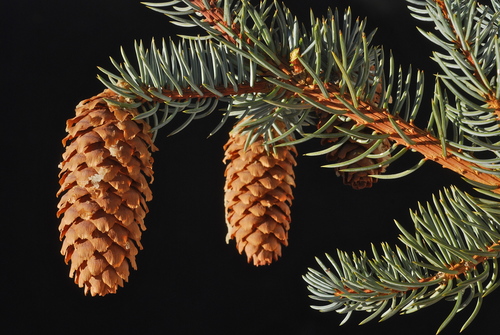
blue spruce
Picea pungens
The blue spruce is the crown jewel of the Rocky Mountains, famous for its striking silvery-blue needles and perfect pyramidal shape. A backyard favorite, it serves as a year-round fortress for songbirds and a resilient sentinel against the winter wind.
Quick Identification
Size
Typically reaches 15–23 meters (50–75 feet) in landscapes, but can exceed 37 meters (120 feet) in the wild, with a spread of 3–6 meters (10–20 feet).
Colors
Signature silvery-blue to blue-green needles; bark is grayish-brown and becomes deeply furrowed with age.
Key Features
- Stiff, sharp needles about 1 inch long that grow all around the branch
- Distinctive pyramidal or conical growth habit
- Dull brown, paper-like cones 2-4 inches long
- Waxy 'glaucous' coating on needles providing the blue hue
When You’ll See Them
Geographic range
Where Does the blue spruce Live?
The blue spruce is native to the majestic Rocky Mountain region of North America, with its core range spanning through Colorado, Utah, Wyoming, and New Mexico, extending into parts of Idaho and Arizona. While its natural ancestors are mountain dwellers, this iconic tree has been successfully introduced as an ornamental across much of the Northern United States, Southern Canada, and even parts of Europe. Today, you are just as likely to find a blue spruce in a quiet suburban cul-de-sac in Ohio as you are on a high-altitude slope in the Rockies.
Basemap © OpenStreetMap contributors
Behavior
The blue spruce is a hardy, long-lived conifer known for its slow-to-medium growth rate and incredible resilience. In the wild, it often grows near mountain streams and in valley bottoms where moisture is more consistent. While it is a solitary species by nature, it plays a vital role in its ecosystem by providing dense, year-round thermal cover for wildlife during harsh winters. Because of its stiff, prickly needles, it is rarely browsed by deer, making it a stable fixture in the landscape.
In suburban environments, the blue spruce is a popular ornamental choice due to its striking color and symmetrical shape. It interacts with humans primarily as a windbreak, a privacy screen, or a focal point in landscaping. Over time, the tree can become quite massive, often outgrowing small residential spaces. It is also the state tree of both Colorado and Utah, holding significant cultural value in the American West.
EverydayEarth exclusive
Camera Tips
When using a trail camera to capture wildlife around a blue spruce, think of the tree as a 'wildlife hub.' Because of its dense needles and protective structure, it is a magnet for birds like nuthatches, chickadees, and crossbills, as well as squirrels looking for a safe place to cache food. Mount your camera on a nearby fence post or a heavy tripod about 4–6 feet away from the outer branches, angling it slightly upward to capture the activity within the lower and middle canopy.
For the best visual results, position your camera so the tree is backlit by the early morning or late afternoon sun. This lighting makes the silvery-blue waxy coating on the needles glow, creating a professional-looking 'hero shot' of the tree while you wait for animals to appear. If you are specifically looking to capture bird life, consider placing a suet feeder near one of the sturdier branches within the camera's field of view; the blue spruce provides the perfect 'staging area' where birds will land and look around before hopping onto the feeder.
During the winter months, the blue spruce becomes even more important for wildlife photography. It is often the only splash of color in a snowy landscape and serves as a vital windbreak. Set your camera to 'Time Lapse' mode during a light snowfall to capture the beautiful accumulation on the branches, or use high-sensitivity motion triggers to catch owls or hawks that may use the tree’s sturdy top as a hunting perch during the night.
Similar Species
Species that look similar or are commonly confused with blue spruce.
Norway Spruce
Norway spruce has dark green needles and distinctive drooping 'weeping' secondary branches, unlike the stiff horizontal branches of the blue spruce.
White Spruce
White spruce needles are shorter and blunter; when crushed, they give off a pungent, almost skunk-like odor that blue spruce lacks.
Engelmann Spruce
Engelmann spruce needles are softer and more flexible, and its cones are smaller with papery, wavy scales compared to the larger blue spruce cones.
Frequently Asked Questions
Record blue spruce at your habitat
Connect a camera to start building your own species record — AI identifies every visitor automatically.