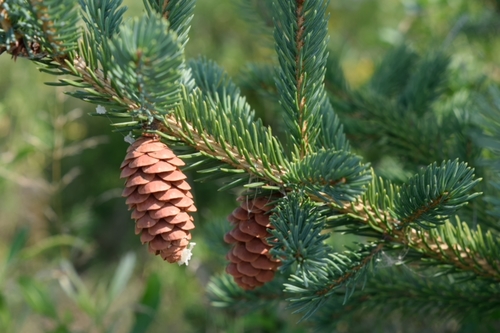
white spruce
Picea glauca
The White Spruce is the 'Great White North's' most resilient sentinel, a shimmering evergreen that provides a year-round sanctuary for backyard wildlife. Its needle-sharp beauty and sturdy branches make it a favorite for nesting birds and foraging squirrels alike.
Quick Identification
Size
40-80 feet (12-25 meters) tall; 1-2 feet (30-60 cm) trunk diameter
Colors
Blue-green to silvery-green needles; ash-brown flaky bark; light brown cylindrical cones
Key Features
- Four-sided needles that roll easily between fingers
- Crushed needles produce a pungent, skunk-like odor
- Cylindrical cones approximately 2 inches long with smooth scales
- Dense, conical crown with branches that often reach the ground
When You’ll See Them
Behavior
The White Spruce is a long-lived, hardy evergreen that serves as a cornerstone of the North American boreal forest. Unlike deciduous trees that shed their leaves, the White Spruce maintains its needles for several years, allowing it to begin photosynthesis the moment temperatures rise in the spring. It is a slow to moderate grower, often acting as a 'climax species' that eventually dominates a forest canopy after faster-growing trees like birch or aspen have died off.
Ecologically, these trees are vital social hubs for wildlife. They provide dense, wind-proof thermal cover for deer and grouse during brutal winters, while their seeds provide a high-energy food source for a variety of finches and squirrels. In a backyard setting, they act as natural sound barriers and windbreaks, creating a calm microclimate that attracts birds that might otherwise avoid open spaces.
EverydayEarth exclusive
Camera Tips
When filming a White Spruce, you aren't just capturing a tree; you're capturing a multi-story apartment complex for wildlife. To see who is visiting, mount your camera on a sturdy stake or a neighboring tree about 10 feet away from the spruce's mid-section. This angle allows you to see birds like Nuthatches and Chickadees flitting in and out of the dense cover. If you're using an AI-powered camera, ensure the 'motion zone' doesn't include the very tips of the branches, as the wind can cause constant false triggers.
For the best visual results, position the camera so the sun is behind it, illuminating the tree's silvery-blue needles during the 'golden hour' (shortly after sunrise or before sunset). If you want to capture the mammals that use the tree for food, place a camera near the base of the trunk. Red squirrels often use the lower branches as 'middens,' where they pile up cone scales after eating. A low-angle shot here will capture high-speed activity and great 'foraging' footage.
During the winter, the White Spruce becomes a literal life-saver for birds. If you have an AI camera with night vision, point it toward the leeward side of the tree (the side protected from the wind). You might capture owls using the dense interior for a daytime roost or small mammals seeking shelter in the snow-well created around the trunk. Finally, consider a long-term time-lapse setting—one photo a day for a year—to see the incredible transition from spring bud-break to a heavy winter snow-load.
Similar Species
Species that look similar or are commonly confused with white spruce.
Black Spruce
Smaller and more slender, typically found in bogs, with shorter needles and smaller, rounded cones.
Norway Spruce
Non-native with much longer cones and distinctive drooping, 'weeping' branchlets.
Blue Spruce
Identified by its more intense silvery-blue color and needles that are significantly sharper and more painful to touch.
Frequently Asked Questions
Record white spruce at your habitat
Connect a camera to start building your own species record — AI identifies every visitor automatically.