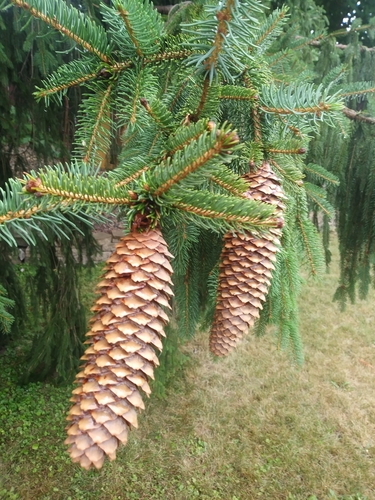
Norway spruce
Picea abies
A towering icon of the northern landscape, the Norway spruce is a year-round haven for backyard wildlife. From its pendulous branches to its massive cones, this hardy evergreen provides the ultimate sanctuary for birds and mammals alike.
Quick Identification
Size
Height: 35-55 m (115-180 ft); Trunk diameter: 1-1.5 m (3.3-4.9 ft)
Colors
Dark green needles; reddish-brown to grey-brown scaly bark; light brown mature cones
Key Features
- Pendulous (drooping) branchlets on mature branches
- Large, cigar-shaped cones 9–17 cm (4–7 in) long
- Sharp, four-sided needles that roll easily between fingers
- Symmetrical, pyramidal crown that broadens with age
When You’ll See Them
Behavior
The Norway spruce is a fast-growing, long-lived conifer that serves as a cornerstone of its ecosystem. Unlike many other spruces, mature specimens develop a distinctive 'weeping' appearance as their secondary branchlets hang vertically from the main limbs. This structural habit helps the tree shed heavy snow loads in winter, preventing limb breakage during harsh storms.
As a foundation species, the Norway spruce interacts with wildlife primarily through its heavy seed production and dense cover. It undergoes 'mast years,' where it produces an overwhelming abundance of cones to ensure seed survival against foragers. For humans, it is a staple of forestry and landscaping, often used as a windbreak due to its dense, year-round foliage and tolerance for various soil types.
EverydayEarth exclusive
Camera Tips
When using a trail camera around a Norway spruce, think of the tree as a vertical highway for wildlife. The dense interior of the spruce is a favorite roosting spot for owls and a nesting site for songbirds. To capture these residents, mount your camera on a nearby structure or another tree facing the spruce's mid-canopy. If you are looking for ground-dwellers like squirrels or chipmunks feeding on fallen seeds, place the camera 12-18 inches off the ground, angled toward the base of the trunk where cone scales often accumulate.
The Norway spruce's low-hanging branches offer a unique opportunity for 'natural housing.' If you place a camera inside the outer perimeter of the branches looking toward the trunk, you can often capture wildlife seeking shelter from rain or snow. This 'under-the-canopy' view provides a rare glimpse into the private lives of birds and small mammals during inclement weather when they are otherwise hidden from view.
Seasonal timing is crucial for capturing specific behaviors. In late autumn and winter, focus your camera on the upper branches where Red Squirrels or Crossbills congregate to extract seeds from the large cones. Because the needles are so dark, ensure your camera has a high-quality infrared flash for night shots, as the deep shadows within the spruce can be difficult for entry-level sensors to penetrate. Set your trigger speed to the fastest possible setting to catch the quick movements of birds flitting between the dense needles.
Similar Species
Species that look similar or are commonly confused with Norway spruce.
Blue Spruce
Blue spruce has silvery-blue needles and much smaller, papery cones compared to the large, woody cones of the Norway spruce.
White Spruce
White spruce has shorter cones (under 2 inches) and its needles produce a pungent, skunk-like odor when crushed.
Red Spruce
Red spruce has shorter needles and smaller, ovoid cones, and lacks the dramatic drooping branchlets of the Norway spruce.
Frequently Asked Questions
Record Norway spruce at your habitat
Connect a camera to start building your own species record — AI identifies every visitor automatically.