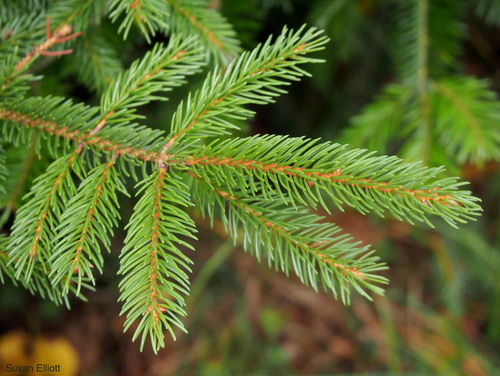
red spruce
Picea rubens
The red spruce is the rugged evergreen of the Appalachian highlands, characterized by its shimmering yellow-green needles and distinctive reddish bark. A cornerstone of eastern forests, it provides essential shelter and food for a vast array of woodland wildlife.
Quick Identification
Size
Typically 18-35 meters (60-115 feet) tall with a trunk diameter of 30-60 centimeters (12-24 inches).
Colors
Dark yellow-green to shiny green needles; reddish-brown scaly bark; cones are purplish-green when young, maturing to a reddish-brown.
Key Features
- Four-sided needles that roll easily between fingers
- Reddish-brown hairy texture on young twigs
- Small egg-shaped cones that fall off shortly after maturity
- Conical crown with slightly drooping branches
When You’ll See Them
Behavior
The red spruce is a slow-growing, resilient conifer known for its longevity, with many specimens living for over 200 years. It is exceptionally shade-tolerant during its youth, often persisting in the understory for decades until a gap in the forest canopy allows it to surge toward the sunlight. This patient growth strategy makes it a staple of late-successional forests in eastern North America.
Ecologically, the red spruce acts as a foundational species. Its dense, evergreen foliage provides critical thermal cover for white-tailed deer and snowshoe hares during harsh winters. It also serves as a vital nesting site and food source for various avian species, particularly those adapted to coniferous habitats. While it doesn't 'behave' in the animal sense, it responds to its environment by shedding lower branches in dense stands and producing large 'mast years' of cones to ensure the survival of its seeds against hungry foragers.
EverydayEarth exclusive
Camera Tips
When using an AI-powered camera to capture the life around a red spruce, placement is key. Instead of mounting the camera directly to the spruce, place it on a neighboring tree or a tripod 10 to 15 feet away. Angle the lens slightly upward to include both the textured reddish-brown bark and the lower evergreen branches. This perspective allows the AI to better distinguish between the stationary tree and the movement of visiting wildlife, such as red squirrels or northern flickers, which are frequently drawn to the seeds and insects found in the bark.
To capture the most interesting biological events, focus your camera on a cluster of cones during the late summer and autumn. Red spruce cones hang downward and transition from a deep purple to a warm brown as they mature. If your camera has a time-lapse feature, this is the perfect opportunity to document the opening of the cone scales. In winter, the red spruce becomes a hub for activity; positioning your camera to face the 'drip line' (the area on the ground directly under the outer edge of the branches) is a great way to catch deer or grouse seeking shelter from the snow.
Adjusting your camera's sensitivity is crucial when monitoring an evergreen. The fine needles of the red spruce can catch the wind and trigger many 'false' recordings. Use your camera's software to set a specific detection zone on the trunk or a sturdy primary limb where birds are likely to land. Since these trees often grow in dense, shaded stands, ensure your camera's low-light or night-vision settings are optimized. A high-resolution setting is recommended to capture the unique 'hairy' texture of the reddish twigs, which is a primary identification feature of the species.
Similar Species
Species that look similar or are commonly confused with red spruce.
White Spruce
White spruce has blue-green, glaucous needles that emit a pungent, skunk-like odor when crushed, unlike the citrus-pine scent of red spruce.
Black Spruce
Black spruce has smaller, rounder cones that stay on the tree for many years and is typically found in boggy, poorly drained soils.
Balsam Fir
Balsam fir has flat needles that cannot roll between your fingers and cones that stand upright on the branches like candles.
Frequently Asked Questions
Record red spruce at your habitat
Connect a camera to start building your own species record — AI identifies every visitor automatically.