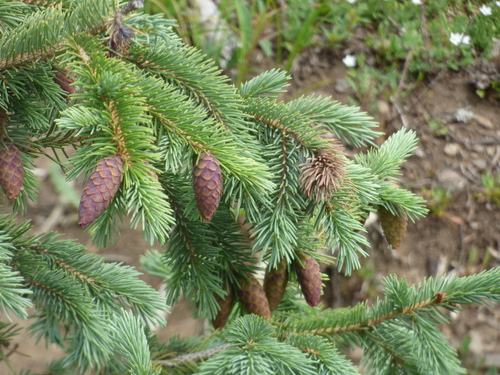
Engelmann spruce
Picea engelmannii
The Engelmann spruce is the silver-crowned monarch of the high Rockies, providing a rugged sanctuary for mountain wildlife and the world's finest wood for acoustic instruments.
Quick Identification
Size
Reaches heights of 25–40 meters (80–130 feet) with a trunk diameter of 0.6–1.5 meters (2–5 feet)
Colors
Deep blue-green to glaucous silver-green needles; gray to reddish-brown flaking bark
Key Features
- Narrow, spire-like conical crown
- Four-angled needles that roll easily between fingers
- Thin, scaly bark flaking in small circular plates
- Small pendulous cones with papery, wavy-edged scales
When You’ll See Them
Geographic range
Where Does the Engelmann spruce Live?
The Engelmann spruce is a quintessential resident of the high-country wilderness in Western North America. Its native range extends from the interior mountains of British Columbia and Alberta southward through the Cascade Range and the length of the Rocky Mountains. It reaches its southern limits in the high-altitude 'sky islands' of Arizona and New Mexico, where it clings to the coolest, highest peaks available.
Basemap © OpenStreetMap contributors
Behavior
The Engelmann spruce is a long-lived, slow-growing conifer that serves as a cornerstone of high-elevation ecosystems. Known for its exceptional shade tolerance when young, it often begins life in the understory of lodgepole pines or subalpine firs, eventually overtopping them to form dense, majestic stands. These trees are highly adapted to harsh winters, with a narrow, flexible shape designed to shed heavy snow loads without breaking limbs.
Ecologically, the Engelmann spruce acts as a vital sanctuary for mountain wildlife. It provides critical thermal cover for elk and deer during storms and offers nesting sites for high-altitude bird species. While it doesn't 'behave' in the animal sense, it responds dynamically to its environment through seed masting cycles, producing enormous quantities of cones every few years to ensure the survival of the species against seed predators like squirrels and nutcrackers.
EverydayEarth exclusive
Camera Tips
When capturing the Engelmann spruce on a trail camera, focus on the 'habitat shot' rather than just the trunk. Position your camera 15-20 feet away from a mature specimen to capture the distinctive spire-like silhouette against the sky. Because these trees often grow in dense clusters, look for an individual on the edge of a clearing or a 'frost pocket' where the dramatic blue-green needles will pop against the background.
For those interested in the wildlife that frequents these trees, aim your camera at the lower branches or the base of the trunk during late summer and fall. This is when Red Squirrels (chickarees) are most active, harvesting cones to cache for winter. Placing a camera near a fallen, decaying spruce log can also capture fascinating footage of martens and weasels that use these logs as hunting corridors and denning sites.
Seasonal settings are crucial. In winter, the Engelmann spruce creates high-contrast scenes with heavy snow. Adjust your camera's exposure compensation to +1 or +2 if possible to prevent the white snow from making the tree look like a dark silhouette. Time-lapse mode is particularly effective for this species; a photo taken once a week over a year can beautifully document the shedding of snow, the emergence of bright pink young cones in spring, and the dusting of new growth.
If you are looking for the 'silver' sheen that gives it the name Silver Spruce, try to angle your camera to catch the morning sun. The waxy coating on the needles reflects early light brilliantly, providing a shimmer that identifies the species even from a distance. Avoid placing cameras too close to the sticky resin-filled bark, as 'pitch' can easily smear onto lenses if the camera is bumped by curious bears or elk.
Similar Species
Species that look similar or are commonly confused with Engelmann spruce.
Blue Spruce
Has sharper, more rigid needles and larger cones; typically found at lower elevations than the Engelmann.
Subalpine Fir
Features upright-growing cones and flat, blunt needles that cannot be rolled between the fingers.
Sitka Spruce
A coastal giant with flatter, sharper needles that grows in the Pacific fog belt rather than high inland mountains.
Frequently Asked Questions
Record Engelmann spruce at your habitat
Connect a camera to start building your own species record — AI identifies every visitor automatically.