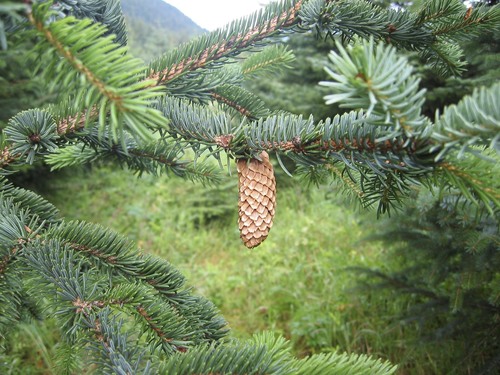
Sitka spruce
Picea sitchensis
The towering titan of the Pacific Coast, the Sitka spruce is the world's largest spruce species and a foundational pillar of the temperate rainforest.
Quick Identification
Size
Height up to 100 meters (330 feet); Trunk diameter can exceed 5 meters (16 feet).
Colors
Steel-blue to dark green needles with silvery-white undersides; bark is grayish-brown to purplish-brown.
Key Features
- Stiff, sharp needles that are painful to touch
- Thin, papery cones with wavy margins
- Grayish-brown bark that flakes off in circular scales
- Massive, deeply buttressed base on mature specimens
When You’ll See Them
Behavior
Ecologically, the Sitka spruce serves as a massive multi-story habitat. Its sturdy, horizontal branches support thick mats of moss and ferns, creating an entire 'canopy soil' ecosystem high above the ground. It is a long-lived giant, with some individuals reaching 700 to 800 years of age, providing stability and carbon sequestration for centuries.
EverydayEarth exclusive
Camera Tips
When using an AI-powered camera near a Sitka spruce, your primary goal is to capture the incredible diversity of wildlife that uses the tree as a hub. Because these trees are often massive, don't try to capture the whole tree in one frame. Instead, mount your camera about 5-6 feet up the trunk facing a nearby game trail or a 'nurse log'—a fallen Sitka spruce where new life is growing. This is a magnet for small mammals like Douglas squirrels and martens.
If you are looking for larger predators, place your camera near the base where the large buttressed roots create natural 'alcoves.' Black bears often use these roots for scratching posts, and Roosevelt elk may use the dense lower boughs for thermal cover during winter storms. Set your trigger sensitivity to high, as the swaying of heavy branches in the wind can sometimes create false triggers, and you want to ensure the AI prioritizes animal movement over branch sway.
For bird enthusiasts, the Sitka spruce is a prime location for raptors. If you have a weather-proof trail camera with a wide-angle lens, consider mounting it higher up (if safe) or pointing it toward the mid-canopy where Bald Eagles and Sitka Spruce Grouse frequently perch. Because the forest floor in Sitka groves is often dark, ensure your camera has high-quality infrared flash or low-light CMOS sensors to avoid grainy footage in the perpetual twilight of the rainforest.
Lastly, don't forget the seasonal changes. While the tree is evergreen, the cone production cycle attracts massive numbers of crossbills and nuthatches in late summer and autumn. Aiming your camera at a cluster of low-hanging cones during these months can provide spectacular footage of specialized feeding behaviors that you won't see at any other time of the year.
Similar Species
Species that look similar or are commonly confused with Sitka spruce.
Western Hemlock
Hemlock needles are short, flat, and blunt with a soft texture, unlike the prickly needles of the Sitka spruce.
Douglas Fir
Douglas firs have deeply furrowed, corky bark and distinctive 3-pointed bracts sticking out of their cones, which Sitka cones lack.
Engelmann Spruce
Engelmann spruce grows at much higher elevations inland, whereas the Sitka is strictly a coastal species.
Frequently Asked Questions
Record Sitka spruce at your habitat
Connect a camera to start building your own species record — AI identifies every visitor automatically.