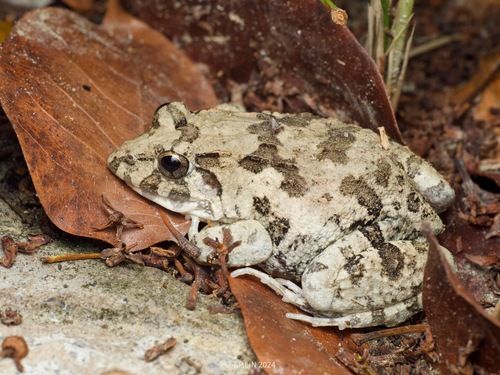
Paddy Field Frog
Fejervarya limnocharis
The agile acrobat of the rice fields, this warty-skinned jumper is a master of camouflage and a tireless predator of garden pests. Watch for the signature cream stripe down its back as it navigates the damp corners of your backyard.
Quick Identification
Size
3.5 to 5 cm (1.4 to 2 inches) in length; typically weighs less than 15 grams
Colors
Olive, gray, or brown dorsal skin with irregular dark blotches; most individuals feature a thin, pale cream or yellow vertebral stripe; creamy white underbelly.
Key Features
- Distinctive narrow pale line running down the center of the back
- Pointed snout with dark vertical bars on the upper lip
- Warty, textured skin with longitudinal skin folds
- V-shaped ridge or dark mark between the eyes
When You’ll See Them
Behavior
The Paddy Field Frog is a highly adaptable, semi-terrestrial species that has successfully integrated into human-modified landscapes. Unlike more aquatic frogs that spend most of their time submerged, this species is frequently found hopping through moist grass, leaf litter, or along the muddy banks of ditches and fields. They are renowned for their agility, utilizing powerful hind legs to make sudden, erratic leaps to evade predators like snakes and birds.
During the breeding season, which is heavily dictated by the monsoon rains, males become highly territorial and vocal. They gather in shallow, temporary pools or flooded fields to produce a rhythmic, pulsed quacking sound to attract mates. Outside of breeding, they are relatively solitary hunters. They play a vital role in local ecosystems by controlling insect populations, making them a welcome guest for gardeners and farmers alike.
EverydayEarth exclusive
Camera Tips
To capture the best footage of a Paddy Field Frog, you need to get low. These frogs spend their lives inches from the ground, so mounting your camera on a tripod or a specialized ground stake just 4 to 6 inches above the surface is essential. Angle the lens slightly downward to capture the texture of the frog's skin and its distinctive vertebral stripe. Because these frogs are small, a camera with a close focal distance is preferred to avoid blurry images when they hop near the lens.
Since these are nocturnal creatures, your camera’s infrared (IR) performance is critical. Use a 'no-glow' or 'black' IR flash to prevent startling the frog or causing it to hop away mid-capture. Be mindful of 'white-out'—at such close range, a powerful flash can overexpose the subject. If your camera settings allow it, reduce the flash power or place a small piece of semi-transparent tape over a portion of the flash to soften the light for that perfect nighttime portrait.
You can effectively lure Paddy Field Frogs into your camera's field of view by manipulating their environment. Place your camera near a small, shallow water feature or a consistently damp patch of soil. Even better, position a low-intensity solar light near the camera; the light will attract nocturnal insects like moths and gnats, creating a concentrated 'buffet' that will keep the frog stationary in front of the lens for longer periods. Set your camera to video mode or a high-speed burst, as their movements are lightning-fast and a single trigger might only catch a disappearing leg.
Similar Species
Species that look similar or are commonly confused with Paddy Field Frog.
Frequently Asked Questions
Record Paddy Field Frog at your habitat
Connect a camera to start building your own species record — AI identifies every visitor automatically.