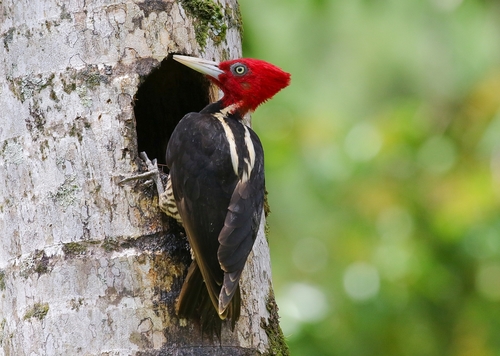
Pale-billed Woodpecker
Campephilus guatemalensis
The Pale-billed Woodpecker is a scarlet-crested architect of the tropical forest, known for its iconic 'double-tap' drum. A master of excavation, this large and vocal bird is a crown jewel for any backyard observer in Central America.
Quick Identification
Size
Length of 33–38 cm (13–15 inches); wingspan approx. 60–70 cm (24–28 inches); weight 200–280g (7–10 oz)
Colors
Jet-black body with a white 'V' on the back; males have a fully red head and crest; females have a black forehead/throat and a red crest; ivory-pale bill
Key Features
- Massive ivory-colored, chisel-like bill
- Male's head is entirely bright red with a bushy crest
- Distinctive 'double-tap' drumming sound (BAM-bam)
- White stripes on the back meet to form a sharp 'V' shape
When You’ll See Them
Geographic range
Where Does the Pale-billed Woodpecker Live?
The Pale-billed Woodpecker is a quintessential species of the Neotropics, primarily found throughout Central America and the southern reaches of North America. Its native range begins in the coastal lowlands of Mexico, stretching across the Yucatan Peninsula and through the dense jungles of Belize, Guatemala, and Honduras. It continues south through the volcanic ridges of Nicaragua and the biodiversity hotspots of Costa Rica, eventually reaching its southern limit in western Panama. Within this region, it is a permanent resident, favoring humid lowlands over high-altitude cloud forests.
Basemap © OpenStreetMap contributors
Behavior
The Pale-billed Woodpecker is a powerful and charismatic presence in the tropical canopy, famous for its 'double-tap' drum—two rapid, resonant strikes that can be heard from nearly a kilometer away. These birds are generally found in pairs or small family groups, moving with a heavy, undulating flight from one large tree to the next. They are methodical foragers, spending significant time on a single trunk, using their powerful necks to hammer away bark in search of deep-seated larvae.
Socially, they are territorial but less aggressive than some smaller species, often communicating through loud, nasal calls. While they are naturally wary of human presence, they can become quite bold if they inhabit forest edges or large gardens adjacent to protected areas. Watching them work is a masterclass in avian engineering, as they use their stiff tail feathers as a tripod to stabilize themselves while delivering bone-shaking blows to the wood.
EverydayEarth exclusive
Camera Tips
To capture the Pale-billed Woodpecker on a trail camera, focus your efforts on 'snags'—large, standing dead trees. These are the bird's primary grocery stores and communication hubs. Mount your camera at a height of 3 to 5 meters (10–15 feet) if possible, angled slightly downward toward a section of the trunk where you see evidence of fresh bark stripping or large, rectangular excavation holes.
Since these birds are large and move vertically, a vertical camera orientation (if your mount allows) or a wide-angle lens is preferred to ensure you don't just capture a tail or a head. Use a camera with a lightning-fast trigger speed (0.3 seconds or less), as woodpeckers can be surprisingly twitchy. Setting your camera to 'Burst Mode' is essential to catch the moment of impact during a drum or the extraction of a large grub.
While they don't typically visit standard bird feeders, you can attract them to a camera zone by providing a large, stable water basin or a 'suet log'—a piece of dead wood with holes drilled into it filled with high-fat bird suet or peanut butter mixed with mealworms. Place these in a shaded area to prevent the suet from melting in the tropical heat and to ensure the lighting on your camera doesn't blow out the bird's bright red crest.
Lastly, pay attention to the audio. If your camera records sound, place it near a known 'drumming tree.' The Pale-billed's signature double-tap is so distinct that even a low-quality audio recording can provide positive identification. Early morning, just after sunrise, provides the best natural lighting and is their most active foraging period.
Similar Species
Species that look similar or are commonly confused with Pale-billed Woodpecker.
Lineated Woodpecker
Has a white line across the face and a more barred underbelly compared to the solid black and 'V' back of the Pale-billed.
Crimson-crested Woodpecker
Two white stripes on the back that do not meet in a 'V' and a slightly different facial pattern; mostly found further south in Panama and South America.
Frequently Asked Questions
Record Pale-billed Woodpecker at your habitat
Connect a camera to start building your own species record — AI identifies every visitor automatically.