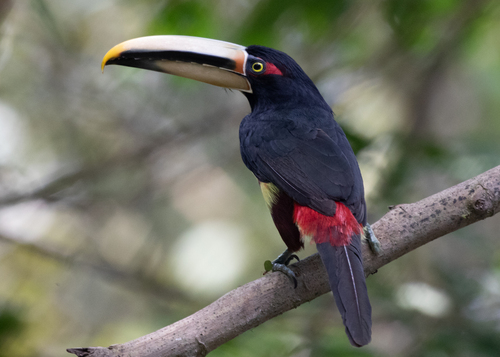
Pale-mandibled Aracari
Pteroglossus erythropygius
With its striking ivory bill and vibrant plumage, the Pale-mandibled Aracari is a crown jewel of the tropical canopy. A social and curious toucan, it brings a splash of prehistoric beauty to any backyard garden near the forest edge.
Quick Identification
Size
Length: 40–48 cm (16–19 in); Weight: 210–310 g (7.4–10.9 oz)
Colors
Black head and neck; yellow underparts with a single black spot on the breast and a red-and-black abdominal band; distinctive pale ivory or bone-colored upper mandible; bright red rump.
Key Features
- Large, pale ivory-colored bill with a dark ridge
- Bright red patch on the lower back and rump
- Single black spot on the yellow chest
- Yellow belly crossed by a mixed red and black band
When You’ll See Them
Behavior
The Pale-mandibled Aracari is a highly social and charismatic member of the toucan family. Often seen traveling in small, noisy groups of 5 to 15 individuals, these birds move through the canopy with a mix of direct flight and agile hopping. They are known for their communal living habits, often sharing a single tree cavity for sleeping with several other members of their flock, which helps with protection and warmth during the night.
While they are primarily fruit-eaters, they are opportunistic foragers. In a backyard or garden setting, they are quite bold and can become accustomed to human presence if there are reliable food sources nearby. They communicate with high-pitched 'pseek' calls and sharp rattles that often give away their location before you see them darting through the foliage. Their flight is characteristic of toucans—a few rapid flaps followed by a glide.
EverydayEarth exclusive
Camera Tips
Capturing the Pale-mandibled Aracari on camera requires a focus on height. These birds spend the majority of their time in the sub-canopy and mid-levels of the forest. If you have a backyard with tall trees, mount your AI-powered camera at least 10 to 15 feet off the ground, angled slightly downward toward a known perching branch or a bird feeder. Using a ladder or a pole-mounted system is often necessary to get the lens into their typical line of sight.
To attract them effectively, use 'wet' fruit lures. Pale-mandibled Aracaris are particularly fond of overripe papayas, bananas, and plantains. Secure the fruit firmly to a branch or a platform feeder to prevent them from flying off with the whole piece. Because they are social, once one bird finds the fruit, the entire troop is likely to follow, providing excellent multi-subject photo opportunities. Set your camera to burst mode or high-frame-rate video to capture their active, jerky head movements and social interactions.
Timing is critical; they are most active shortly after sunrise when they emerge from their roosting cavities to feed. If you can locate a roosting hole—usually an old woodpecker cavity—place your camera nearby to catch them entering or exiting. For the best color saturation on their pale bills and yellow bellies, aim for areas with dappled sunlight rather than harsh, direct midday sun, which can wash out the details of their ivory mandibles. Ensure your camera’s trigger speed is set to its fastest setting, as they can be surprisingly quick when jumping between branches.
Similar Species
Species that look similar or are commonly confused with Pale-mandibled Aracari.
Frequently Asked Questions
Record Pale-mandibled Aracari at your habitat
Connect a camera to start building your own species record — AI identifies every visitor automatically.