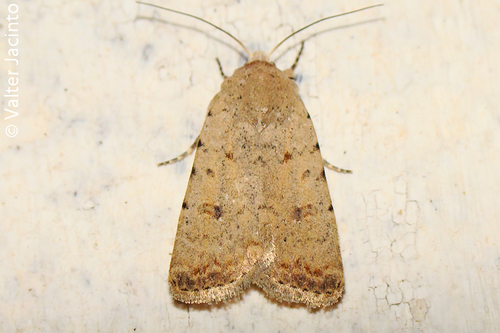
Pale Mottled Willow Moth
Caradrina clavipalpis
An understated master of camouflage, the Pale Mottled Willow Moth is a fascinating nocturnal visitor that has recently begun a successful trek across North America. Its subtle, sandy-grey wings hide a remarkable story of adaptation to human-dominated landscapes.
Quick Identification
Size
Wingspan of 26-35 mm (1.0-1.4 inches); body length roughly 12-15 mm (0.5-0.6 inches).
Colors
Soft greyish-brown or sandy forewings with distinct dark spots; hindwings are notably pale, almost white or silvery.
Key Features
- Four small dark spots or dashes along the leading edge (costa) of the forewing
- Pale, translucent hindwings that are much lighter than the forewings
- Compact, flattened resting posture where wings overlap tightly over the abdomen
When You’ll See Them
Behavior
The Pale Mottled Willow Moth is a resilient and adaptable nocturnal insect that has successfully transitioned from its native European range to North America. It is frequently associated with human environments, often seeking shelter inside barns, sheds, and houses during the day or during colder snaps. This behavior has earned it a reputation as a 'commensal' species, one that lives comfortably alongside human activity without causing significant harm.
In the wild, these moths are active from late spring through early autumn, typically producing two or more generations per year. They are strong flyers and are highly attracted to artificial light sources. When disturbed during the day, they exhibit a rapid, erratic flight before quickly settling back down into a crevice or against a textured surface where their mottled grey wings provide excellent camouflage against stone or weathered wood.
EverydayEarth exclusive
Camera Tips
To successfully document the Pale Mottled Willow Moth with an AI-powered camera, you should capitalize on its attraction to light. Setting up a 'moth wall'—a white sheet illuminated by a UV or mercury vapor light—is the most effective method. Secure your camera on a tripod focused on a specific 12-inch square area of the sheet. Since these moths are relatively small, using a macro lens or a close-up attachment is essential to capture the identifying spots on the forewings. Set your camera’s trigger sensitivity to 'high' or use a time-lapse setting that takes a photo every 2-5 minutes to catch visitors as they land.
Another excellent method is to use 'sugar baiting.' Mix fermented fruit, brown sugar, and a bit of yeast into a thick paste and paint it onto a tree trunk or a fence post in your yard. Position your camera about 18 inches away from the bait. The Pale Mottled Willow is a frequent visitor to these sweet lures. Unlike some flighty species, they often settle for long periods while feeding, allowing you to capture crisp, high-resolution images. Ensure your flash is diffused to avoid washing out the subtle grey patterns on their wings.
Because this species often hides in man-made structures, consider placing a camera near the eaves of a shed or near a porch light that is left on overnight. Look for vertical surfaces where the moth can press itself flat. If you are using a motion-activated camera, try to minimize background interference like swaying branches, as the moth's small size may require you to turn up the sensitivity, which can lead to many 'empty' triggers if the area is too busy.
Similar Species
Species that look similar or are commonly confused with Pale Mottled Willow Moth.
Frequently Asked Questions
Record Pale Mottled Willow Moth at your habitat
Connect a camera to start building your own species record — AI identifies every visitor automatically.