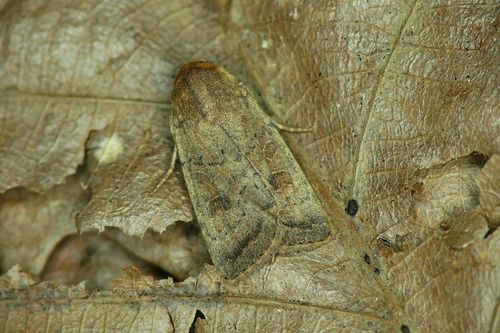
The Rustic
Hoplodrina blanda
A master of nighttime camouflage, The Rustic is the understated star of the midsummer garden. Look closely at its silky grey wings to discover a world of subtle, intricate markings.
Quick Identification
Size
Wingspan of 31–35 mm (approx. 1.2–1.4 inches); body length roughly 15 mm (0.6 inches).
Colors
Forewings are a silky, uniform mouse-grey to warm brown; hindwings are distinctively pale, almost whitish, with darker veining.
Key Features
- Smooth, glossy texture on the forewings
- Dark, well-defined kidney and oval-shaped markings
- Whitish hindwings with a slight pearly sheen
- Wings held flat and overlapping when at rest
When You’ll See Them
Behavior
The Rustic is a classic representative of the Noctuidae family, often categorized by casual observers as a 'Little Brown Moth.' Despite its unassuming name, it is a highly active nocturnal flyer. During the day, it remains perfectly camouflaged against bark or tucked into dense garden foliage, only emerging once dusk has fully settled. It is a solitary species, though you may find several individuals congregating around high-quality nectar sources or artificial lights.
In the garden, The Rustic is a frequent visitor to summer-blooming flowers. It has a steady, direct flight pattern compared to the erratic flitting of smaller moths. While it doesn't interact with humans directly, it is one of the most common species to find resting on window screens or fluttering around porch lights on warm July nights. Its life cycle is closely tied to the ground, with larvae spending their time feeding on low-growing 'weeds' before pupating in the soil.
EverydayEarth exclusive
Camera Tips
To capture high-quality images of The Rustic, you'll need to lure them to a specific 'stage' where your camera can focus. Because they are nocturnal, the best method is to use a light trap or a 'sugar station.' Set up a white sheet with a UV or bright LED light shining on it; place your AI-powered camera on a tripod about 2–3 feet from the sheet. This creates a high-contrast background that helps the camera's AI identify the wing shapes and markings more accurately.
Another excellent method for backyard observation is 'sugaring.' Mix a concoction of overripe bananas, brown sugar, and a splash of dark beer, then paint this onto a tree trunk or fence post at eye level. Mount your camera nearby with a focus distance set to the treated area. The Rustic is highly attracted to fermented sweets and will often sit still for long periods while feeding, allowing for crystal-clear macro shots of their subtle wing patterns.
For camera settings, ensure your device is set to its highest resolution. If your camera has a 'night mode' that utilizes infrared, you'll get great behavioral shots, but a flash is often necessary to distinguish The Rustic from its very similar cousins. Position the camera at a slight 45-degree angle to the surface where the moth lands to minimize glare from the wings' silky scales. Since peak activity is mid-summer, ensure your camera's batteries are fully charged for those long, warm nights when moth activity is at its highest.
Similar Species
Species that look similar or are commonly confused with The Rustic.
Frequently Asked Questions
Record The Rustic at your habitat
Connect a camera to start building your own species record — AI identifies every visitor automatically.